
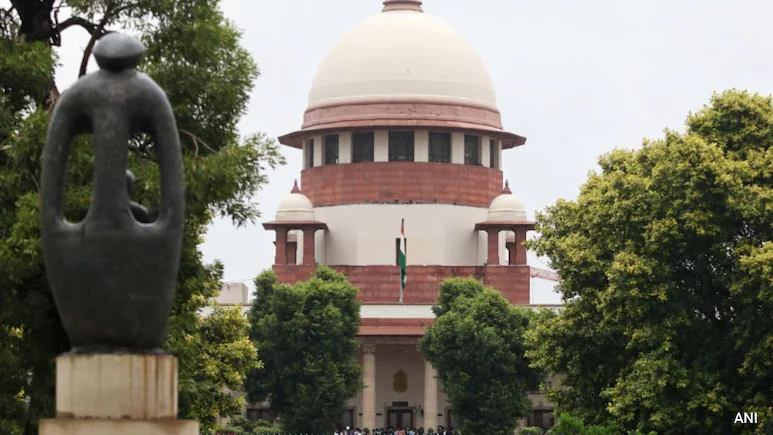
The Supreme Court on Thursday said it is “baffled” with the growing cases of digital arrest cyber frauds in the country, wondering how can anyone in a democractic nation believe they are being arrested over a mobile phone call.
This is being reported in the media all the time!” the Chief Justice remarked. Chief Justice Surya Kant questioned why people still fall for the traps set by fraudsters, despite constant media coverage and ongoing awareness campaigns. “We are baffled – why don’t people understand? What is the issue with the victims? Are they not ordinary, sensible people? “In a democratic nation, how could anyone possibly believe that they are being ‘arrested’ over a mobile phone call? Just throw your mobile against the wall – the threat of arrest will vanish,” he added. The amicus curiae noted that the fear of arrest places victims under immense mental pressure. The Chief Justice observed that merely preparing reports after an incident has occurred will not solve the problem. “A report is essentially a post-mortem. What about prevention? The Chief Justice also questioned why effective action is not being taken when bank officials themselves are allegedly found to be involved in such scams. “The problem is that bank officials are involved. Even now, when we are calling for action, the RBI is still in the process of consulting with the banks,” he remarked. The Attorney General clarified that action has been taken in cases where the involvement of officials has been established. He stated that it would be unfair to label all bank employees as colluding with fraudsters, adding that the RBI is in the process of expediting relevant procedures.
The Supreme Court indicated that if banks fail to exercise due diligence, leading to incidents such as ‘digital arrests’ or other forms of cyber fraud, they could be directed to compensate the victims and face prosecution. * Automatically notifying the relevant police station * Conducting physical verification to ensure the authenticity of a transaction * Establishing a mechanism to compensate victims in cases where cyber fraud occurs due to bank negligence * Directing the RBI to consider a framework for such compensation * In its order, the top court noted that the Attorney General, representing the Central Government, submitted a note on October 28 regarding the proposed directives The bench expressed its inclination to issue the directives suggested by the amicus curiae and the Central Government; however, it will first examine the RBI’s proposed ‘KYC Amendment Directions, 2026’. She cited a recent incident involving a woman who was allegedly defrauded of Rs 2.5 crore. The lawyer noted that even though the Central Government had submitted a status report on March 30, the number of ‘digital arrest’ cases continues to rise. These amended directives should be notified by November 30 and implemented in December, according to the court.
Why can’t a transaction be stopped the moment it takes place?” the Chief Justice said.
A bench led by Chief Justice Surya Kant questioned how despite awareness campaigns, media reports, and court orders, even educated individuals continue to fall victim to such scams. The three-judge bench, which also included Justice Joymalya Bagchi and Justice V Mohana, was hearing the matter of ‘digital arrest’ scams, having taken suo motu cognisance of the issue. Senior lawyer and amicus curiae NS Nappinai informed the court that such cases continue to emerge despite ongoing efforts to curb them. Some psychologists describe this state as akin to hypnosis, which explains why people fall victim to scams despite being aware of the risks. The Chief Justice remarked that it is concerning that even educated individuals fall prey to such scams. He further advised that the authenticity of any purported court order can be verified by checking the official website of the concerned court. “We propose to issue a directive that in all such instances of fraud, the bank shall compensate the victim and face prosecution. This must be implemented,” the Chief Justice remarked. The Attorney General objected to establishing such accountability through court directives, arguing that the issue of bank liability should be determined by the RBI. Justice Joymalya Bagchi observed that strict accountability could be imposed upon financial institutions. The Court indicated that the RBI, in its capacity as the regulator, must formulate appropriate guidelines in this regard. The top court stressed that any unusual transaction – one that does not align with an account holder’s historical transaction pattern – should be temporarily halted pending verification. Measures highlighted by the court include: * Identifying suspicious transactions that deviate from an account holder’s typical transaction behavior * Temporarily halting such transactions until their legitimacy is verified
The Chief Justice questioned why banks should not be held accountable for losses suffered by victims due to fraud – especially given that banks often enter into ‘one-time settlements’ involving crores of rupees in loan recovery cases.
Questioning the security protocols of banks and other agencies, the Supreme Court asked why security mechanisms do not immediately activate to halt suspicious transactions as soon as they occur. Attorney General R Venkataramani informed the court that banks are now better equipped to identify suspicious transactions compared to six months ago. He added that meetings have been held with the Reserve Bank of India (RBI) to formulate regulations, and the Indian Cyber Crime Coordination Centre (I4C) is operating around the clock.
