
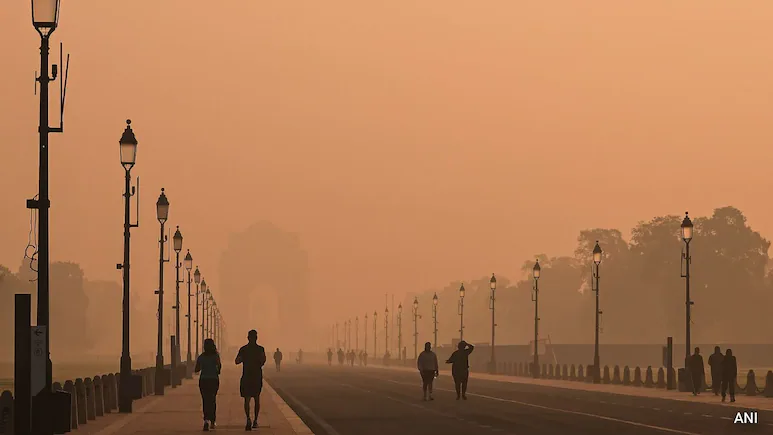
Delhi’s AQI at 369 was in the ‘very poor’ category on Saturday as smog enveloped the city on the eve of Diwali and reduced visibility.
The data was provided by the Consortium for Research on Agroecosystem Monitoring and Modelling from Space (CREAMS) Laboratory of the Indian Agricultural Research Institute in its bulletin. Satellite data showed that 589 residue-burning incidents were detected across six states on Friday. Of these, 357 were reported in Punjab, nine in Haryana, 23 in Uttar Pradesh, 58 in Rajasthan, three in Uttarakhand and 139 in Madhya Pradesh.
The air quality is forecast to turn ‘severe’ on Sunday, with Diwali celebrations, vehicular emissions and the peak stubble-burning season expected to add to the pollution burden. Weather and air quality experts have attributed the anticipated deterioration to unfavourable meteorological conditions, the onset of Diwali-related celebrations and vehicular emissions, and the peak period of stubble burning in neighbouring states. Of the 59 monitoring stations that recorded data on Saturday, air quality remained in the ‘severe’ category for 16, while for 29, it was in the ‘very poor’ category. The worst AQI was recorded near IIT Delhi at 452. As per the Central Pollution Control Board (CPCB), an AQI between 0 and 50 is classified as ‘good’, 51 and 100 as ‘satisfactory’, 101 and 200 as ‘moderate’, 201 and 300 as ‘poor’, 301 and 400 as ‘very poor’, and 401 and 500 as ‘severe’. The transport sector was the largest contributor to the city’s pollution on Saturday, accounting for 21.4 per cent, according to the Decision Support System (DSS) for Delhi. The contribution of stubble burning was pegged at 1.7 per cent, with forecasts suggesting that it might go up to 5.4 per cent on Sunday.
