
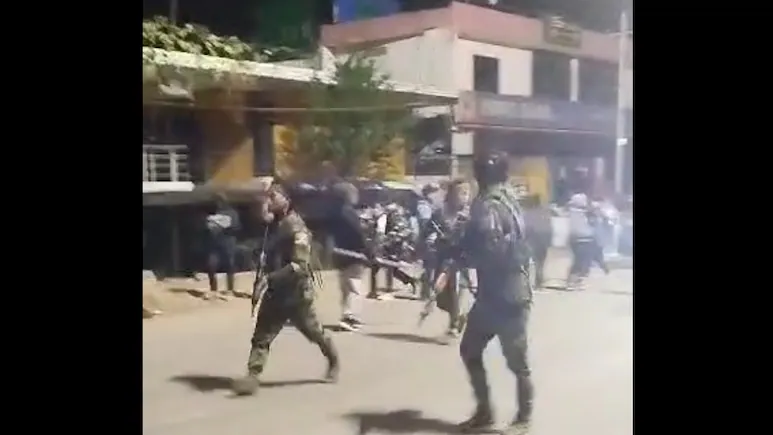
A comprehensive review of the security arrangements in Manipur, an impartial crackdown on armed groups and the recovery of illegal weapons are essential to restoring public confidence and paving the way for lasting peace, participants at a key discussion in Delhi said.
A major concern raised during the discussion was the continued presence of illegal weapons and armed groups in Manipur. The panel called for impartial action against all armed organisations, irrespective of their ethnic identity or community affiliation, along with effective measures to recover looted and illegally held weapons. Linking the issue to India’s constitutional commitment to unity in diversity, the participants cautioned that the erosion of communal coexistence in Manipur could have implications extending beyond the state. The discussion expressed reservations about proposals to reorganise territory along ethnic lines, with the participants arguing that the creation of separate territories would not by itself resolve the underlying disputes over identity and other matters. Citing Assam’s experience, they observed that territorial division was not necessarily a durable solution to conflicts arising from overlapping territorial claims and competing political aspirations. The panel examined the influence of the drug economy and cross-border criminal networks on the prevailing situation. Participants alleged that vested interests, including individuals operating from Myanmar, were exploiting narcotics networks to influence developments in the region and fuel instability. The panel sought a review of the suspension of operations (SoO) agreement with Kuki insurgent groups, questioning whether the arrangement had achieved its stated objectives. It called for a thorough examination of its implementation, monitoring mechanisms and overall effectiveness. Under the agreement’s ground rules, cadres were required to remain in designated camps while their weapons were to be kept in locked storage and subjected to periodic inspections. A joint monitoring group was entrusted with overseeing its implementation while the agreement was reviewed annually for extension. The initiative was intended to reduce violence in the hill districts, lower the burden of counter-insurgency operations and create an enabling environment for political negotiations and development. The Delhi meeting, however, stressed that any arrangement with armed organisations must demonstrate tangible progress towards disarmament and accountability. The panel at the discussion organised by the Meitei Alliance and the Meitei Heritage Society (MHS) called for a comprehensive approach that combines effective security measures and institutional accountability. The Meitei Alliance is a global umbrella body of civil society organisations of Manipur’s Meitei community, while the MHS is a civil society group of the community engaged in public activities for development and peaceful coexistence. Journalist Subir Bhaumik, Lieutenant General Himalaya Singh (retired), professors Arambam Noni and AC Kharingpam, and former adviser to the Manipur chief minister, Rajat Sethi, attended the panel.
READ | 17 Men Claiming To Be Kuki Cadres Arrested, Arms Seized In Manipur Reconciliation must remain central to any effort to resolve the crisis, they said, adding the communities of Manipur have no viable alternative to peaceful coexistence despite their distinct identities, historical experiences and political aspirations. READ | Manipur’s Lifeline Opens For 1st Time Since 2023, Interstate Bus Service To Resume To tackle the problem, the meeting recommended the use of drones, satellite imagery and aerial surveillance to identify and target illegal poppy cultivation and called for a concerted crackdown on the financial networks, trafficking routes and other criminal structures sustaining the narcotics trade. The tripartite SoO agreement was formalised in 2008 between the Centre, the Manipur government and more than two dozen armed groups operating under two umbrella organisations – the Kuki National Organisation (KNO) and the United People’s Front (UPF). As part of the rehabilitation arrangement, cadres covered by the agreement were provided a monthly stipend of Rs 6,000.
The Manipur crisis could not be addressed merely as a law-and-order or security issue nor could it be viewed exclusively through the prism of ethnic divisions, the participants who included former security officials, lawyers and civil society representatives said, adding that a broader political and social response was needed to examine the underlying causes of the prolonged crisis and explore possible solutions. They said security operations alone without a credible political process could not deliver lasting peace in Manipur. Any negotiation without accountability and the impartial enforcement of law would be insufficient to rebuild public trust, they said.
