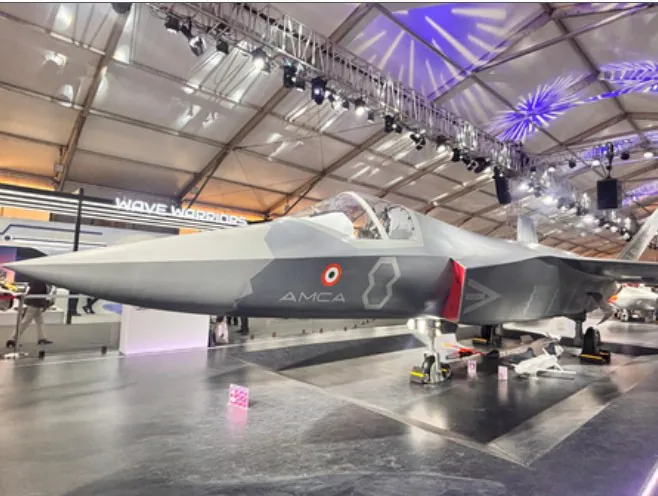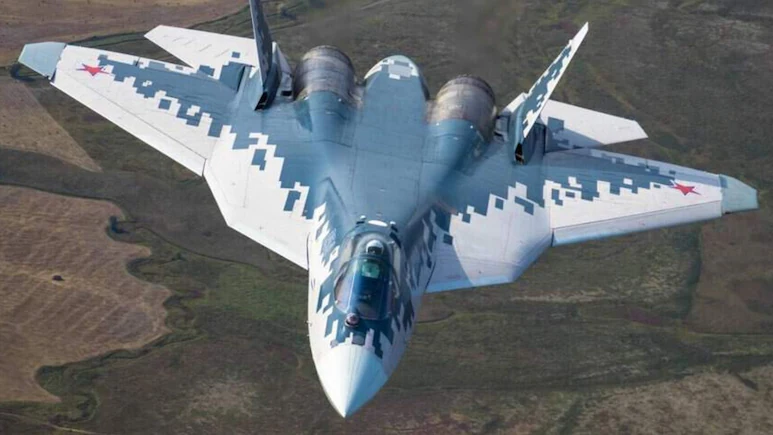
The government has not taken any decision so far on the acquisition of the Russian Sukhoi-57 stealth fighter jet despite the overwhelming gap with the Chinese Air Force. China is believed to operate approximately 500 radar-evading J-20 and J-35 fighter jets while India presently has none in service with the indigenous Advanced Medium Combat Aircraft (AMCA) close to a decade from its initial entry into Indian Air Force (IAF) service, assuming it clears integration and flight trials.
“As of now, our fifth-generation fighter aircraft programme is AMCA. But we’ll see where it goes. Singh was speaking in the presence of the Russian Ambassador to India Denis Alipov, who also spoke at the event. Significantly, Singh spoke about the continued relevance of the Tejas platform going forward despite the jet not being designed to be stealthy or radar evading, now the norm for modern combat platforms. He pointed to India’s evolving network of sensors which are as important in air combat operations as the aircraft itself.
The first AMCA prototype is expected to roll out in September 2028, according to India’s Defence Secretary RK Singh. Russia has been pushing hard for India to acquire the Su-57 jet which was showcased in February 2025 at Aero India, Asia’s largest airshow. Russia has offered licenced production of the Su-57 in India with deep tech transfer.
“On the induction of fifth-generation fighter aircraft from global sources, the government has not taken a decision as yet,” Singh said at the NDTV Defence Summit 2026.
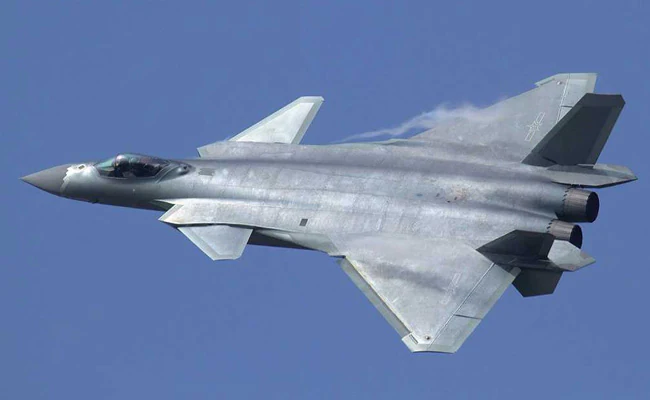
For now, New Delhi appears to be betting that networks, sensors and software can buy time until the indigenous AMCA arrives. Because pakistan has signed an initial agreement to acquire Chinese J-35 stealth fighters and China is already flight-testing its next-generation J-36, widening a gap India’s planners cannot ignore, it is a calculated gamble. India has to see how quickly the AMCA moves from the drawing board to the runway and whether an AI-enabled network can truly compensate for the stealth India lacks While Moscow’s Su-57 offer remains on the table.
The IACCS, the IAF’s automated network, links radars, sensors, air defence units and command centres across the country. It fuses their data into a single real-time picture of the airspace, so commanders can detect threats and direct fighters and air defence weapons quickly. “It (Tejas jets) can’t have the stealth features that these two aircraft that you mentioned (Chinese J-20 and J-35 platforms) have but in a lot of other ways in terms of evasion and in terms of target acquisition, a good network with a good AI layer can do a lot of those things.
“We have a very good network available – the (IAF’s) IACCS (Integrated Air Command and Control System) which is also getting combined with the army’s network and with our air defence network, there are ways of putting in an artificial intelligence layer on it to improve the performance of your 4.5 generation fighters,” Singh said. We will have to look at all of those technological solutions even as we face this technological gap as you mentioned,” he said.