
Written by Prem Kant Tiwari
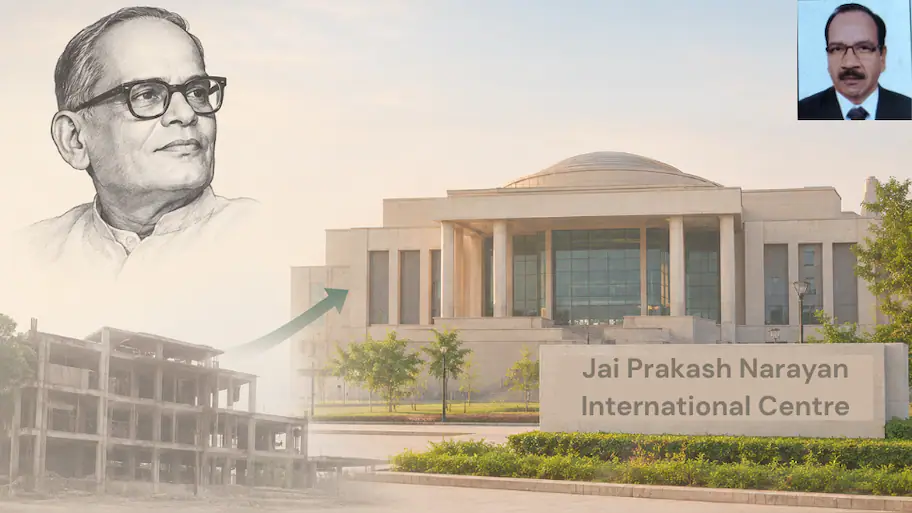
The Jai Prakash Narayan International Centre (JPNIC), located in Gomti Nagar, Lucknow, has for years stood as an incomplete structure that the city sees every day but cannot put to use. During the Samajwadi Party regime, the project, named after Loknayak Jai Prakash Narayan, became a dark saga of public money being squandered, political conspiracy and administrative negligence, with no end in sight. This has strengthened the possibility that the centre may finally see better days. One major factor was the inclusion of a large number of non-scheduled items. Since government Schedule of Rates were not available for these items, market rates were adopted, leading to a substantial increase in expenditure. Transparent rate-setting mechanisms are established for government construction precisely to prevent arbitrary pricing. When these mechanisms are bypassed, the justification of market rates can often become another name for a free hand in spending. More serious still is the fact that no separate approval was obtained for the cost escalation. Air-conditioning work was also undertaken beyond the originally approved scope. Facilities such as a rooftop swimming pool, gym and cafeteria were also built without approval. Setting rules and procedures aside in this manner makes a mockery of the entire framework of accountability. Let us now turn to the operating arrangement. The very composition of the society constituted to run JPNIC raised questions. Non-governmental and family members were made lifetime and founder members. The list included former Chief Minister Akhilesh Yadav, his wife and MP Dimple Yadav, former Chief Minister’s private secretary Gajendra Singh, Samajwadi Party spokesperson and MLA Rajendra Chaudhary, MP Dharmendra Yadav, Anju Narayan, Wasif Hasan and Anupama Prakash. The performance guarantee provides financial assurance that the operator has a tangible incentive to honour the contract. No government funds will now be used for the remaining project work or its maintenance in any manner. This marks a fundamental shift from the previous arrangement. Another aspect deserves attention. The consortium will operate the hotel, convention centre, auditorium, parking facilities and sports facilities. However, the rights to operate and maintain the Jai Prakash Narayan Museum within the complex will remain with the LDA or the government. This division of responsibilities appears sensible. Commercial activities should remain in commercial hands, while public control should be retained over the section associated with the memory and legacy of Loknayak Jai Prakash Narayan. After all, this centre is not merely a hotel or an auditorium. It bears the name of a personality who went beyond the politics of power to lead a mass movement.
The sanctioned cost of the air-conditioning plant was ₹32 crore, but it was subsequently increased to ₹42 crore. The authority and the state government will be able to use the museum for up to 50 days a year without any charge.
Now, under the Yogi government, the Lucknow Development Authority (LDA) has paved the way for its operation through a new model, bringing the earlier arrangement to an end. Where the burden of investment earlier fell on the public exchequer, that responsibility now rests with the private party.
The biggest lesson from this project transcends politics. Regardless of which government is in power, whenever work on public projects begins without the requisite approvals, rates are fixed arbitrarily and the benefits of facilities are restricted to a select few, the taxpayer ultimately bears the cost. JPNIC’s past serves as a warning, while its present offers an opportunity. The present reality is that Lucknow is set to get a centre that will strengthen the city’s economic and cultural identity without increasing the burden on the public.
It is therefore essential that the procedural reforms introduced now become a permanent part of the institutional framework.
