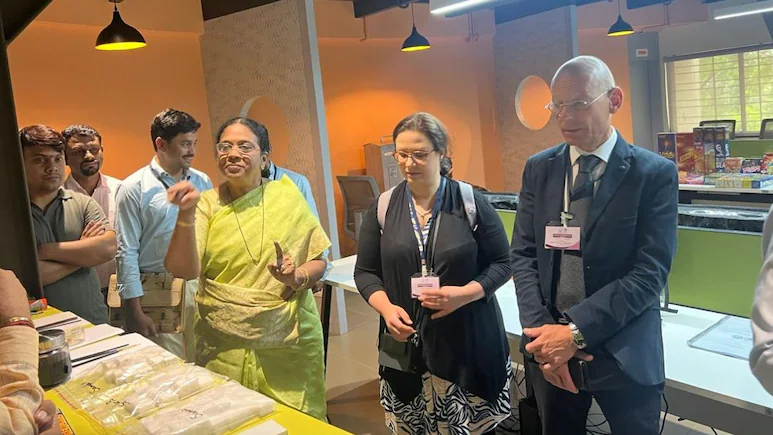
Nine years ago, as Delhi’s air turned toxic after Diwali and concerns over pollution mounted across India, a challenge was thrown at Indian scientists. The challenge came in 2017 from Dr Harsh Vardhan, then Union Minister for Science and Environment and an ENT surgeon by training, who believed science could help preserve tradition while reducing environmental damage.
After pioneering India’s first-generation green crackers and helping drive second-generation formulations, her focus has shifted to what may become the next frontier in fireworks technology.
The breakthrough was significant. Scientific studies had repeatedly shown spikes in particulate matter, sulphur dioxide and nitrogen oxides after large-scale bursting of fireworks. The first-generation green crackers were developed by a team led by Dr Sadhana Rayalu, then a senior scientist at the National Environment and Engineering Research Institute, Nagpur (CSIR-NEERI). The formulation reduced the use of toxic components, including barium, and modified the chemical composition of conventional crackers through special additives and catalysts. Faced with growing concerns over air pollution, the court repeatedly examined the environmental impact of fireworks and pushed for cleaner alternatives. Green crackers eventually emerged as a scientific response to judicial and public health concerns. Scientists argued that the green cracker program helped create a regulated pathway where cleaner fireworks could remain available while reducing environmental damage.
Because of their contribution to air pollution, especially in North India during winter, post-Diwali, until then, firecrackers had become the focus of an intense national debate. Because of the interventions of the Supreme Court, the effort also gained importance. It was in 2018 that NDTV first exclusively broke the story that India’s efforts to develop green crackers had come to fruition. Dr Harsh Vardhan, Science and Environment Minister, had told NDTV on October 29, 2018: “We have announced the production of green crackers where the cost will be something like 15-30 percent less, these crackers will have 25-30% less particulate matter and fifty percent less sulphur dioxide and NOx potential and be less polluting to the environment and these can be manufactured by the industry that already exists in the country with a Rs 6000 crore economy and 5 lakh workers and they will be able to manufacture them at the same facility without disturbing anything, this is happy news. This came after scientists from the Council of Scientific and Industrial Research (CSIR) took on the challenge and developed India’s first generation of green firecrackers capable of reducing pollution by about 30 per cent compared to conventional fireworks. Scientists said these changes could reduce particulate emissions by roughly 30 to 40 per cent while still retaining the light and sound effects associated with fireworks.