
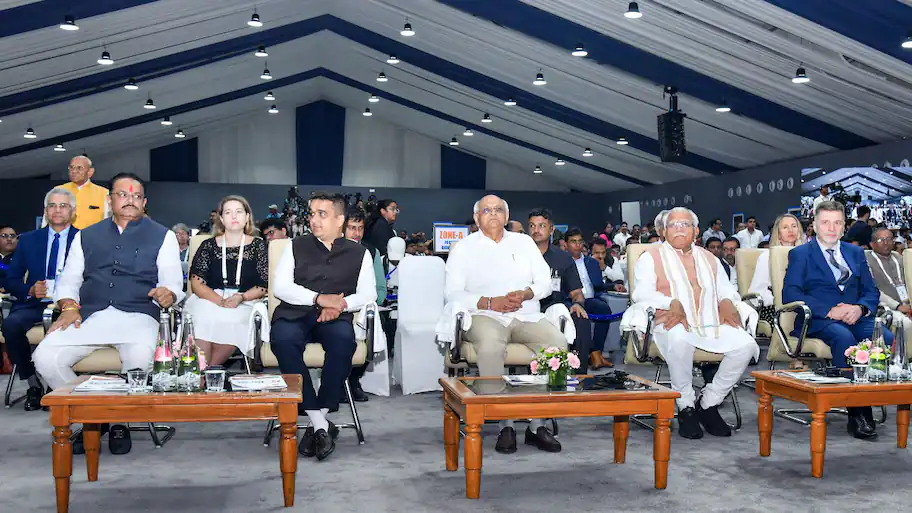
Highlighting its record and governance as part of its vision for a ‘Viksit Gujarat’ (Developed Gujarat), the state claims to have made progress across established sectors and emerging industries, including semiconductors, renewable energy, artificial intelligence, green hydrogen, electronics, space technology, shipbuilding and advanced manufacturing. Gandhinagar : Gujarat Chief Minister Bhupendra Patel will complete five years in office on September 13.
The government says several of the initiatives are part of the programmes launched during Prime Minister Narendra Modi’s tenure as the Gujarat chief minister. It said it has also introduced new schemes, administrative reforms and infrastructure projects to support economic growth and improve public services. The government says Gujarat has also launched the country’s first Tribal Genome Sequencing Project. The state launched the ‘Healthy Gujarat, Obesity-free Gujarat’ campaign on the World Obesity Day. The scheme aims to help girls continue their studies, and the government has reported an increase in the number of girls pursuing higher secondary education since its launch.
The state has also become the only one in India to provide digital health cards to school students. AIIMS Rajkot was inaugurated by PM Modi for providing greater access to advanced healthcare facilities. The Aarogya Samiksha Kendra was dedicated to the public to bring the monitoring and review of health services and facilities under one roof. The initiative is intended to support health-related research and facilitate timely diagnosis of diseases among tribal citizens.
The government says the state has increased the health coverage available under the Pradhan Mantri Jan Arogya Yojana-Mukhyamantri Amrutam (PMJAY-MA) from Rs 5 lakh to Rs 10 lakh. More than 2.92 crore citizens, it claims, have been issued Ayushman cards under the scheme. More than 1.15 crore digital health cards have been issued so far, as per the government. The 108 emergency ambulance service received 617 new ambulances. It took the total number of 108 ambulances in Gujarat to 1,455, in addition to existing hospital-based ambulances. Under the Namo Shri Yojana, the Patel government claims, more than 8 lakh women have received financial assistance totalling Rs 540 crore. Gujarat has reported an institutional delivery rate of 99.97%, which the government has described as a national benchmark in maternal and child healthcare. Under the Pradhan Mantri TB Mukt Bharat Abhiyaan, the state government says, 31,021 Nikshay Mitras have registered on the Nikshay portal. A total of 5,76,344 nutrition kits have been distributed to support the dietary needs of TB patients. Across all phases of Mission Indradhanush conducted so far, it claims, 9,95,395 children and 2,25,960 pregnant women have been vaccinated across the satte. Under the Namo Lakshmi Yojana, which was launched in 2024, it claims, over 25 lakh girl students pursuing higher secondary education have received financial assistance of over Rs 2,110 crore. Under the Namo Saraswati Vigyan Sadhana Yojana, the state data says, more than 3.54 lakh students have received Rs 290 crore in assistance from 2024-25 till date. The Mukhyamantri Gyan Sadhana Merit Scholarship Yojana has provided more than Rs 176 crore in financial assistance from 2023-24 till date. The government says the National Education Policy (NEP) 2020 has been implemented across Gujarat. Under the Mission Schools of Excellence programme, it claims, the state has completed 13,353 new classrooms, 21,000 computer labs, 1,09,000 smart classrooms and 5,000 STEM labs. The 2024 recruitment drive resulted into the appointment of 9,400 Shikshan Sahayaks (teaching assistants) and 470 principals in government and non-government aided secondary and higher secondary schools, according to the data. It says, a further 2,230 existing teachers were recruited or transferred. For 2026-27, the government says, approval has been granted for 200 new composite schools, 95 new government secondary schools and three new higher secondary schools. The 24th edition of Kanya Kelavani Mahotsav and Shala Praveshotsav was organised in 2026. The state says the No Detention Policy has been abolished in all schools across Gujarat, while the income limit for Class 1 admission under the Right to Education (RTE) has been increased. The dropout rate for Classes 1 to 8 had fallen from 37.22% in 2001-02 to 2.35% in 2024-25, according to the state government.
Its “largest-ever” state budget of Rs 4.08 lakh crore, 19 sectoral policies, new educational institutions and new public health initiatives are part of the government’s five-year development record. It says it has placed disease prevention, timely diagnosis and effective treatment among its healthcare priorities. Sola Civil Hospital, according to the government, also became home to the country’s first tele-rehabilitation centre. The government says education has been another major part of its five-year programme.
The state has classified data centres as essential services and introduced a mechanism to simplify and speed up project approvals through a single-window system. India’s first UHP welding training programme for the semiconductor industry has been launched at Dholera ITI. Administrative reforms have been introduced to make government services simpler, faster and more transparent, according to it.
These facilities include therapy equipment, digital panels, ramps, railings and toilets for Children with Special Needs (CwSN). The government reports states that the policy places special emphasis on sustainability. Water supply will be arranged through desalination plants that convert seawater into freshwater, with the government stating that this will avoid affecting the water requirements of farmers and other industries. The state claims to have formulated policy in response to the rising importance of digital infrastructure in the era of artificial intelligence and machine learning. Sanand and Dholera are expected to develop into major data centre hubs. The government is also working to establish Dholera as a future headquarters for Global Capability Centres (GCCs). Its semiconductor ecosystem covers manufacturing, assembly, testing, packaging, design and research. Sanand and Dholera are emerging as the main locations for the sector. Micron Technology’s advanced ATMP facility for DRAM and NAND memory chips is operational at commercial scale in Sanand. Tata Electronics is building India’s first commercial semiconductor fabrication plant in Dholera. The industrial city is also seeing the development of India’s first commercial mini and micro-LED display fabrication and packaging unit by Crystal Matrix. The state claims that six semiconductor plants have been approved in Gujarat, with three already operational on a commercial basis. The Dholera Special Investment Region is being developed with large land parcels, reliable power and water supply, plug-and-play facilities and connectivity to ports, airports, expressways and the Delhi-Mumbai Industrial Corridor. Gujarat is also developing the skills and research infrastructure needed for the industry. PDEU, in collaboration with Micron Technology, is developing an ATMP training centre. An advanced semiconductor manufacturing research and training centre named SAMARTH has been established at IIT Gandhinagar in collaboration with MeitY and DST Gujarat. The government has also organised four Vibrant Gujarat Regional Conferences to promote investment and industrial development across different parts of the state. The Uniform Civil Code (UCC) Bill has been passed in Gujarat, which the government has described as a step towards equality, justice and unity. The Gujarat State Institute for Transformation (GRIT) has been established along the lines of NITI Aayog. The Gujarat Administrative Reforms Commission (GARC) has also been constituted to improve the efficiency and effectiveness of the administrative machinery. The initiatives are intended to support data-driven policymaking, efficient administration and outcome-oriented governance. The long-term plan seeks to guide the state’s economic, technological and inclusive development. The Mukhyamantri Paushtik Alpahar Yojana provides nutritious snacks to primary school children in addition to the mid-day meal. The Namo Shree Yojana supports the health and nutrition of pregnant mothers. Revenue reforms have also been undertaken to simplify procedures and accelerate citizen services through technology and streamlined processes. Gujarat’s development plans include a major push into renewable energy, artificial intelligence, semiconductors and advanced manufacturing. The state’s industrial and investment policies are intended to build an ecosystem for emerging sectors. The data centre and semiconductor programmes, along with renewable energy and green hydrogen initiatives, are part of the government’s efforts to develop future-ready infrastructure. The government has described these developments as part of Gujarat’s contribution to the national vision of Atmanirbhar Bharat and Viksit Bharat.
Around 1,68,000 students have been identified through the system and guided to complete their education. Its data suggest that with an aim to support inclusive education, 37 new resource rooms have been established across Gujarat. The government says that it has also created 1,141 new teacher posts for yoga and health education in government primary schools. Over the last five years, 41 new government colleges have been established, including 24 in non-tribal areas and 17 in tribal areas. New streams have been introduced in 15 government colleges. The Mukhyamantri Yuva Swavalamban Yojana has provided Rs 2,068.67 crore in assistance to 3,97,415 students during the last five years. Under the Mukhyamantri Kanya Kelavani Nidhi Yojana, 24,802 girl students have received Rs 797.01 crore, according to the report card. PhD students have received Rs 113.52 crore under the SHODH Scheme over the past five years. Under SSIP 2.0, 6,077 Proofs of Concept have received assistance of up to Rs 2.50 lakh each, resulting in the establishment of 962 startups based on innovative student ideas, claims the report. Chief Minister Bhupendra Patel has announced the Viksit Gujarat Data Centre Policy 2026-29, which is aimed at making the state one of the the biggest data centre hub to support India’s digital and cloud infrastructure ambitions. Data centres will be required to use 51% green energy. The policy targets the development of data centres with a total capacity of 7.5 GW. The report says companies have submitted proposals for projects with a combined capacity of 10 GW in Gujarat. The policy provides additional capital assistance of 2.5% for data centres in Dholera, along with complete exemption from stamp duty. Data centres will receive 4% interest assistance for 10 years and electricity tariff assistance of Rs 1 per unit for the following 20 years, claims the government report. The government performance reports states that Gujarat has got more than US$13.66 billion in semiconductor investments. Of the 12 projects approved by the Government of India, six are located in the state. The facility will manufacture CMOS logic chips using 110 to 28-nanometre process nodes. The state has announced additional capital investment assistance of 40% over and above Central government CAPEX support for semiconductor projects. Other incentives include a 75% subsidy on the initial 200 acres of land required for a FAB project, 100% reimbursement of stamp duty and registration fees and a power tariff subsidy of Rs 2 per unit for 10 years. Over the past five years, the state says, it has implemented 19 policies covering future-oriented sectors such as semiconductors, renewable energy, green hydrogen, electronics, space-tech, Global Capability Centres, data centres, shipbuilding and advanced manufacturing. The conferences generated MoUs worth a combined Rs 17.4 lakh crore. Gujarat has also hosted major international events, including G-20 meetings, the Vibrant Gujarat Global Summit and RE-Invest 2024. The state is preparing to host the Commonwealth Games in 2030. Gujarat has become the first state in the country to prepare a roadmap for Viksit Gujarat @2047, aligned with Prime Minister Narendra Modi’s vision of Viksit Bharat @2047. Gujarat declared 2025 as the Urban Development Year, continuing the urban infrastructure vision associated with Modi’s tenure as chief minister. Youth welfare programmes include the Namo Lakshmi Yojana for girls’ secondary and higher secondary education and the Namo Saraswati Vigyan Sadhana Yojana for students pursuing science in Classes 11 and 12.
It says an AI-based Early Warning System has been implemented to identify students at risk of dropping out. Commercial-scale OSAT facilities by CG Power, Renesas and Stars Microelectronics are also operational there, along with Kaynes Semicon’s high-end chip packaging-based OSAT facility, according to the government report. In Surat, Suchi Semicon is expanding from small-scale production to a full-fledged OSAT facility, the government says. The GTU is establishing a ChipIN extension centre and a Centre of Excellence to train students in VLSI design and the complete chip design process, the government says. Gujarat’s “largest-ever” state budget stands at Rs 4.08 lakh crore. The latest conference, themed ‘Regional Aspirations, Global Ambitions’, was organised to bring in investment opportunities beyond established industrial centres and support regional growth, the report says. Through the Sugam Digital Gujarat initiative, the state says it is working towards paperless, cashless and faceless government services. The state government says it has been working on modern urban infrastructure, transport, amenities and civic services to improve the ease of living in cities.
