
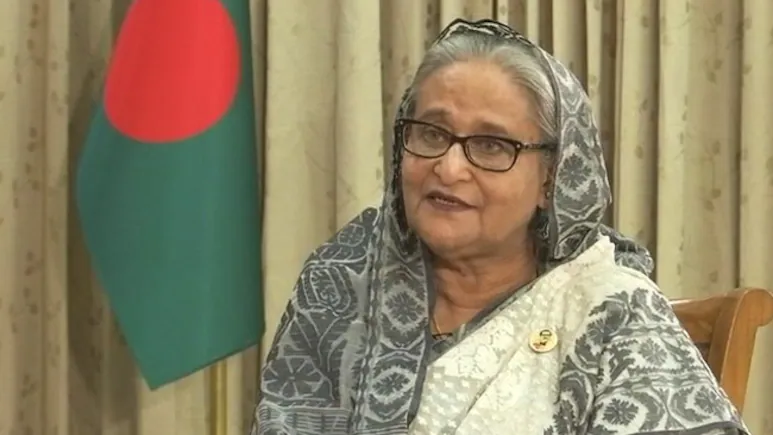
Former Bangladesh prime minister Sheikh Hasina has alleged that religious minorities in Bangladesh are facing growing insecurity and accused authorities of allowing a climate of impunity and political repression to persist.
In a message marking Sharadiya Durgotsav, Hasina said religious and ethnic minorities are living in fear in Bangladesh.
She cited alleged killings, attacks on temples and homes, vandalism of idols, property seizures, extortion, violence against women and intimidation to bolster her point. She also connected the alleged attacks on minorities with what she described as a systematic campaign against the Awami League. Hasina accused the interim administration led by Muhammad Yunus, which succeeded her, of allowing perpetrators of violence to escape accountability while pursuing politically motivated cases against Awami League members. She alleged that political repression and a culture of fear had continued under subsequent political arrangements as well. Hasina sought to contrast the current situation, as she described it, with the commitments made by her Awami League government.
Hasina said the insecurity experienced by minorities had intensified since August 5, 2024, when Bangladesh underwent a major political transition that led to the end of her government’s tenure.
In a message marking Sharadiya Durgotsav, Hasina, who was ousted as prime minister and is living in exile in New Delhi, said Hindu communities and other religious and ethnic minorities are living in fear in Bangladesh. “Religion belongs to each individual, but festivals belong to all,” Hasina said, reiterating her longstanding argument that Bangladesh’s identity should be rooted in religious equality, human dignity and the freedom to practise one’s faith. Party offices were vandalised, looted and set on fire, while the homes, businesses, agricultural land, livestock and other assets of party leaders and activists were targeted, according to her message. She said the party had consistently supported non-communal politics and sought to ensure that people of all faiths could participate in public life with equal dignity.
