
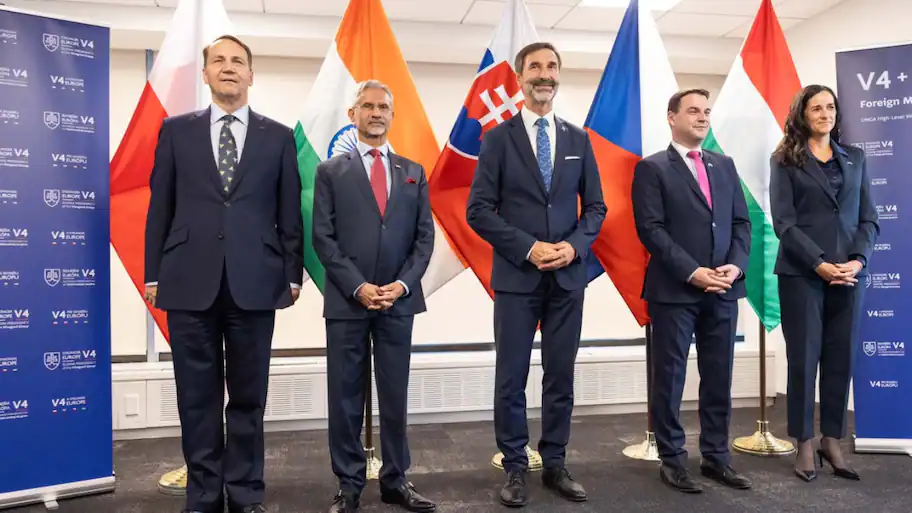
India’s campaign for a permanent seat on the United Nations Security Council received fresh diplomatic support from four Central European countries at the first Visegrad Group (V4)-India meeting in New York. Hungary, Poland, Slovakia and the Czech Republic backed India’s claim during the meeting held on the sidelines of the 81st UN General Assembly.
Slovak Foreign Minister Juraj Blanár described India as an “upcoming superpower” and said it should have a permanent place at the UN’s top security body.
At that time, much of Asia and Africa remained under colonial rule, while several countries that now have major populations, economies and diplomatic influence were not yet independent. New Delhi’s argument for a permanent seat points to its population, economic weight, contribution to UN peacekeeping and growing diplomatic role. India has also been active in areas including counterterrorism, development, maritime security and international peace. It also seeks a structure that reflects the political and economic realities of the present-day world. India’s bid has received support from several permanent members of the Security Council, including France, the United Kingdom, the United States and Russia. New Delhi is also part of the G4 grouping with Brazil, Germany and Japan. The four countries support one another’s bids for permanent membership and coordinate their positions on Security Council reform. Its model calls for six new permanent seats, two for Africa, two for the Asia-Pacific region, one for Latin America and the Caribbean, and one for Western Europe and Others, along with four or five additional non-permanent seats. However, the five existing permanent members, the US, Russia, China, France and the UK, have yet to agree on a common model for expansion. Differences remain over the number of additional seats, regional representation, whether new permanent members should have veto powers and how an expanded Council should operate. China remains the only permanent member that has not explicitly backed India’s bid.
For New Delhi, Security Council reform is therefore about more than securing a permanent seat. India’s case for Security Council reform is rooted in the changing balance of the world since the UN was established in 1945. India has served eight times as an elected member of the Security Council, most recently in 2021 and 2022. The G4 has proposed expanding the 15-member Security Council to 25 or 26 members.
“We all agree, the four countries, that India, as a part of the Global South, an upcoming superpower in the Indo-Pacific region, must be at the table as a permanent member of the UN Security Council,” Blanár told reporters after the meeting with External Affairs Minister S Jaishankar. In its priorities paper for the 81st UNGA, India argued that the UN’s inability to respond effectively to conflicts has raised questions about its “efficacy, credibility and legitimacy”. Beijing has said it understands and respects India’s aspirations while stressing the need for broader consensus on Security Council reform.
It was, in a sense, a new historic occasion, and I would like to thank Minister Juraj (Foreign Minister of Slovakia) for convening us today. One of the most difficult questions in any reform process is the future of the veto, which currently allows the five permanent members to block substantive Security Council decisions. The African Union has called for the eventual abolition of the veto. At the same time, it has argued that if new permanent members are created while the veto remains, they should have the same rights as the existing permanent members. India has taken a similar position. Any final reform would also require amendments to the UN Charter, making broad international support and agreement among existing permanent members essential. The V4 meeting was not limited to Security Council reform. India and the four Central European countries also agreed to deepen cooperation across business, technology, defence, space, connectivity and people-to-people ties. “We had our first Visegrad Four and India meeting. India and the V4 countries agreed to explore an annual business forum and hold regular meetings between their foreign ministers. “The foreign ministers would meet annually. That was the consensus,” he added. Technology and innovation, defence, space, connectivity and mobility were among the other areas discussed. The ministers also exchanged views on major global developments, including the Ukraine conflict and the situation in the Gulf. “We have a very strong history with all the V4 countries in defence. He also highlighted the technological and industrial strengths of the four countries. Deputy Prime Ministers handling foreign affairs, Anita Orban of Hungary, Radek Sikorski of Poland and Petr Macinka of the Czech Republic, represented their countries at the V4 meeting. The grouping initially had three members before Czechoslovakia split into the Czech Republic and Slovakia. Jaishankar, who served in Hungary early in his diplomatic career, also held separate bilateral meetings with the V4 foreign ministers. The V4 endorsement does not by itself secure Security Council reform, which remains dependent on wider negotiations at the UN and the positions of existing permanent members. However, it adds another regional grouping to the list of countries publicly supporting India’s claim for a permanent place on the Council. (With IANS inputs)
In an April 2026 statement, New Delhi said there could not be a separate category of permanent members in which some countries have veto rights while others do not. The Visegrad Group takes its name from the Hungarian city of Visegrád, where the leaders of the member countries first met in 1991.
India has supported an “all or none” approach, under which existing and new permanent members would have the same privileges and responsibilities. Jaishankar described the meeting as a “new historic occasion” and thanked Blanár for convening it. It was a very, very productive meeting,” Jaishankar said. “What we agreed was that since India’s relationship with the European Union itself is deepening, with the V4 we would take some special initiatives to create an annual business forum,” Jaishankar said. Jaishankar said India had a strong history of defence cooperation with the four countries and wanted to build on it. We want to refresh and take forward that record and that cooperation,” he said. “These are industrial economies, economies with great innovation and technology talent,” he said. After meeting Hungary’s Anita Orban, he said on X, “We resolved to work together to deepen our ties, as well as advance the India-European Union Strategic Partnership. Following his meeting with Blanár, Jaishankar said the two sides discussed their bilateral agenda as well as “ways to deepen our multilateral cooperation”.
