
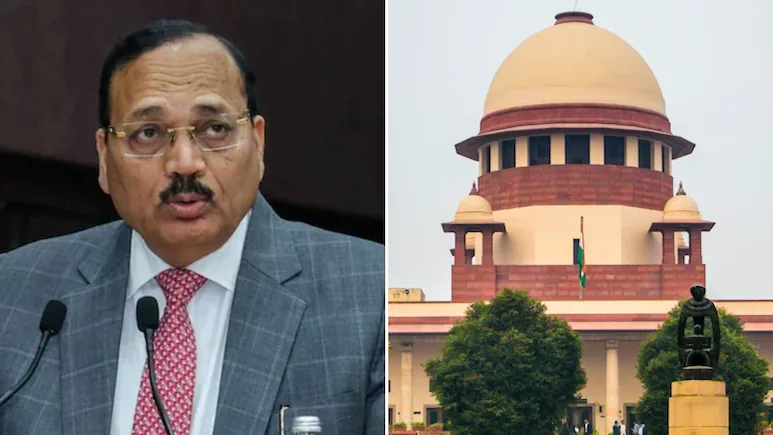
India’s season of protests found mention in the Supreme Court on Wednesday when Chief Justice of India Surya Kant asked a petitioner why he had approached the judiciary and not held an agitation instead.
Speaking in a lighter vein during a hearing on a petition seeking mandatory rotation of constituencies reserved for Scheduled Castes (SCs) and Scheduled Tribes (STs) in Parliament and state Assemblies, the Chief Justice remarked, “You are dialling the wrong number – this is the age of protests and demonstrations. Perhaps you should follow suit. The counsel for the petitioner responded that he had no intention of protesting and had a sore throat besides. “This argument is premised on the assumption that the majority community will vote based on caste or community. That is not necessarily the case. The court cannot make a judicial pronouncement on democratic choices; that is a decision for the voters to make,” Justice Bagchi pointed out. He also noted that a constituency being reserved does not affect an individual’s right to vote. “Your right to vote remains intact. You are free to cast your vote for a candidate from any community. However, claiming that you cannot vote for a candidate from your own community cannot be considered a valid argument. Religion, Caste No Bar
Jagdish Singh, a voter from the 191-Kadipur Assembly Constituency in Uttar Pradesh’s Sultanpur district, had filed a petition challenging the seat’s reservation for SCs for over seven decades since the first election in 1952. He contended that the absence of a rotation mechanism violated Articles 14, 15 and 19 of the Constitution and restricted the electoral choices of voters by limiting the candidates they could elect to members of the SC community.
The petitioner said this had benefited just four or five families and sought, at the very least, that authorities be directed to consider implementing a rotation system for the reservation of Legislative Assembly seats – a practice already in place for Panchayat and municipal body elections. During the hearing, the bench of Chief Justice Kant and Justices Joymalya Bagchi and V Mohana said an assumption cannot be made that voting is based on caste. Furthermore, your right to contest an election is not limited to a single seat; you may choose to contest from other, non-reserved constituencies,” he said.
“Voters are expected to vote for a party and its ideology, not on the basis of religion. One may choose to support or oppose a particular ideology – the identity of the individual representing that ideology becomes irrelevant,” he stressed. The Court declined to intervene in the plea for a rotation system for reserved seats. It added that mere disagreement with the criteria used to select a particular seat for reservation does not render the process unconstitutional. The court’s role is limited to determining whether there is any clear or manifest arbitrariness. Justice Bagchi emphasised that it is for the legislature to assess whether long-term reservation fosters a sense of caste-based division within society. An existing law cannot be declared unconstitutional solely on this basis. ‘Cannot Rewrite Constitution’ The petitioner’s counsel cited Articles 243D and 243T of the Constitution, which provide for reservation and rotation in panchayats and municipalities. Justice Surya Kant then remarked, “You are dialling the wrong number – this is the age of protests and demonstrations. Perhaps you should follow suit. The counsel apologised, stating that he had no intention of staging a protest and that he was suffering from a sore throat.
The bench also observed that while Article 332 of the Constitution provides for the reservation of seats for SCs and STs, the specific determination of which seats are to be reserved is a separate matter.
Justice Bagchi said that, in a multi-party democracy, voters are expected to cast their ballots based on political parties and their respective ideologies, rather than a candidate’s religion or caste. In response, Justice Bagchi said the Constitution contains a separate framework for local body elections and the court could not rewrite Constitutional provisions. “We cannot assume the role of a third chamber of Parliament,” he remarked when the counsel urged the court to interpret the law in a way that would extend the rotation system to Assembly seats. To this, the Chief Justice replied, “You can certainly raise your voice and argue that it is time for Parliament to reconsider this issue, but that is something only the legislature can do.”
