

Amul once ran an advertising campaign saying that the best coalition or the best alliance globally is that of bread and butter. But all parties cannot be natural allies. The question of the current times is whether there could be a new political understanding between the CPI(M) and Mamata Banerjee.
When the BJP made an alliance with the Shiv Sena long ago, politicians said it was a natural alliance, as both parties had some ideological similarities.
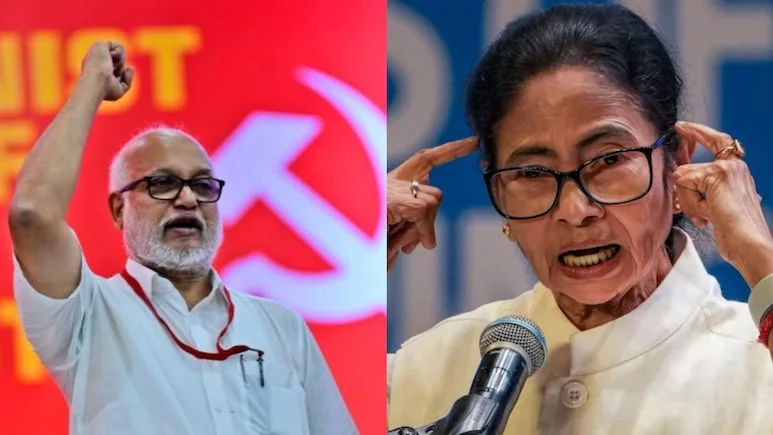
So, if such arrangements were possible in the past, why should a similar understanding be considered impossible today? Mamata Banerjee and CPI(M) general secretary MA Baby recently spoke, after years of rivalry, on the issue of the workings of the Election Commission, triggered once again by a news report that made serious claims. Coalition politics has been a part of Indian politics since the decline of the Congress party in the 1970s. However, in coalition politics, there are both natural allies and unusual or unlikely allies. The letter appears to suggest that, in the face of the present political circumstances, opposition parties should consider developing a joint strategy. This does not necessarily mean that the INDIA alliance is being restructured. Rather, Baby seems to be reaching out to opposition parties more broadly, and he has understood several aspects of the political relationship between himself and Mamata Banerjee. The political dilemma is clear. If the BJP takes a particular position, the opposition must decide how to respond. Similarly, if the opposition wants to present a united front against the BJP, it must consider whether Mamata Banerjee can be part of that effort. However, when it comes to the future of national politics, it is not yet clear whether she can play a decisive role at the national level. If she chooses to focus on national politics, she will have to consider the political consequences for her party in West Bengal. There is also the question of whether the CPI(M) and Mamata’s Trinamool Congress can work together against the BJP at the national level while maintaining their separate political positions in West Bengal. This creates a clear political dichotomy. On the one hand, the CPI(M) cannot easily set aside its opposition to Mamata Banerjee in West Bengal. On the other hand, if Mamata Banerjee wants to help build a national platform against Narendra Modi, she may see an opportunity to bring different opposition forces together. With Gyanesh Kumar becoming a focal point of political controversy and growing public anger, opposition parties and various civil society organisations are also joining the broader movement. Mamata Banerjee may want to take advantage of this political opportunity. But the question remains: Can this two-pronged strategy actually work? The question is whether the CPM and Mamata Banerjee can find common ground despite their deep political differences.
Because of certain ideological similarities among its partners, when the BJP first emerged as a coalition partner, we used to describe it as a natural ally. Because she has established a strong position for her party in West Bengal, mamata Banerjee has considerable political strength. Now, cut to 2026, when the gap seems to be closing between the CPI(M) and Mamata Banerjee at the national level. The first non-Congress coalition government was led by Morarji Desai in 1977. The party cannot remain silent about what it considers to be 15 years of misrule under her government.
This is also when Mamata Banerjee finds herself repeatedly isolated, her power and influence diminished, her party having broken into three parts, and her identity challenged as she now does not have the old “ghas phool” symbol.
However, an understanding between the communists and Mamata Banerjee’s Trinamool Congress (TMC) would be highly unusual. We have not witnessed such an alliance before. During UPA-I, the Left supported the Manmohan Singh government, while Mamata Banerjee was not part of the arrangement. However, when the Left withdrew its support during UPA-II, Mamata Banerjee entered the coalition with her party. Now, following the developments surrounding the Chief Election Commissioner, Gyanesh Kumar, the anti-Gyanesh Kumar protests, and the broader opposition politics, a new development has suddenly emerged. And it is unusual — Mamata Banerjee and MA Baby aligned on a matter. it is not entirely impossible While it may seem unlikely. Someone has to raise the question and examine the possibility. There are also practical considerations. The CPI(M) has members in the Rajya Sabha, and there are questions concerning the party’s parliamentary strength, its political influence, and its future development. However, the issue is not entirely new. At that time, Sitaram Yechury was present, and Mamata Banerjee was also involved. Efforts were made to bring the two sides closer and establish a common understanding. However, the CPI(M) and Mamata Banerjee could not come together. Even the Congress entered into an alliance with the CPI(M), but not with Mamata Banerjee. So, after this letter and Mamata’s call to Baby, the question arises: Is it possible that Mamata Banerjee and the CPI(M) could form a new alliance? A telephonic conversation is one thing. An electoral alliance or a political alliance is an entirely different matter. In West Bengal, the CPI(M)’s state leadership remains highly critical of the Trinamool and Mamata Banerjee. The party’s state secretary, Mohammad Salim, is also a national leader. Other prominent CPI(M) leaders, including Sujan Chakraborty, have also been strongly critical of the Trinamool and Mamata Banerjee. The party’s spokespersons and younger leaders have consistently taken a critical position towards the Trinamool. Even within the Congress, the high command has to take the views of the state Congress leaders into account, and there are significant differences of opinion. A great deal of political analysis suggests that there is a fundamental contradiction in this approach. Their political differences cannot simply be ignored. At the same time, Indian politics has witnessed instances in which parties with opposing ideologies have come together against a common political adversary. For example, during the anti-Indira Gandhi movement, there was a platform on which the communists and the Jan Sangh came together. Similarly, during the period associated with Atal Bihari Vajpayee and VP Singh, Jyoti Basu met Atal Bihari Vajpayee and Lal Krishna Advani. The Jan Sangh and other political forces supported the broader political movement associated with VP Singh, while the Left also supported the opposition effort. There was no direct political alliance between all these parties, but there was an indirect understanding and cooperation.
The possibility of coordination with the Trinamool has therefore become a subject of discussion. On September 23, Baby sent a letter to all opposition leaders, including Mamata Banerjee.
Earlier, when the INDIA alliance was being formed, there were discussions about its leadership and the possibility of bringing different opposition leaders together. The communists and Mamata Banerjee have historically been political opponents in West Bengal.
