
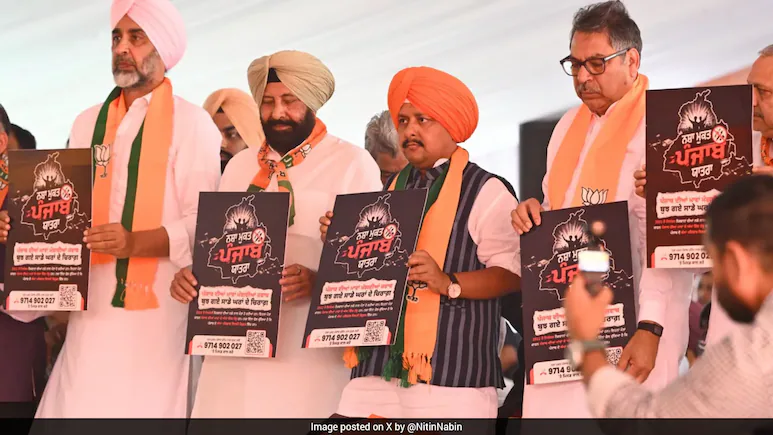
Punjab’s politics is no longer confined to stages, press conferences and large rallies. Increasingly, it is moving onto the roads. Almost every major political party is trying to reach voters through yatras, campaigns, public meetings and constituency-level outreach. The government wants to showcase its record. The Opposition wants to question it. Farmers, unemployment, law and order, industry and governance are all competing for political space.
This time, Punjab BJP president Kewal Singh Dhillon and the party’s state in-charge Satish Poonia have publicly reiterated that go-it-alone position, even though reports of discussions around a possible Akali-BJP understanding have periodically continued. So the larger question behind this yatra is this: Can the BJP transform itself from a party with pockets of support into a statewide organisation? Under Kewal Dhillon, the state unit has spoken about building teams down to the district, block and village levels. Dhillon has also sought to foreground farmers’ welfare, industrial revival and the drug crisis. He has promised that a BJP government would ensure MSP on crops listed by the Centre and has spoken of crop diversification and agricultural incentives. These positions indicate where the BJP understands its political gaps to be. It should be: Who can demonstrate a measurable solution? How many major trafficking networks are dismantled? Where is the supply entering from? How effectively is interstate coordination functioning? How many people complete rehabilitation without relapsing? What happens to an addict after leaving a rehabilitation centre? And where are the jobs, skills, sports facilities and opportunities that can provide vulnerable young people with alternatives? There is also a political counter-argument the BJP cannot avoid. These arguments underline the problem of assigning the drug crisis to one government or one institution alone. The BJP has another challenge closer to home: its own organisation. Recent changes in the Punjab unit have caused dissatisfaction among sections of the traditional cadre, with some leaders questioning the growing influence of politicians who have joined from rival parties. This may eventually become one of the BJP’s most important tests. They can bring recognisable faces, local networks and electoral experience. But an election organisation is ultimately sustained by workers.
Therefore, the question for the BJP — just as it is for the current AAP government and previous governments — cannot simply be, who speaks most strongly against drugs? Because the international border falls within the security responsibilities of central agencies, bhagwant Mann and Arvind Kejriwal have also sought to place responsibility on the Centre over cross-border smuggling. The state’s ruling AAP has questioned the BJP’s campaign by pointing to the years when the party shared power with the Shiromani Akali Dal, 2007 to 2017 in particular, a period during which Punjab’s drug problem was already a major political issue.
Dhillon has acknowledged grievances while rejecting the distinction between an “old BJP” and a “new BJP”.
Political imports can expand a party’s profile; even Dhillon was in the Congress earlier.
The concluding programme is expected to feature Union Home Minister Amit Shah. BJP national president Nitin Nabin launched the first leg from Madhopur in Pathankot on September 18.
