
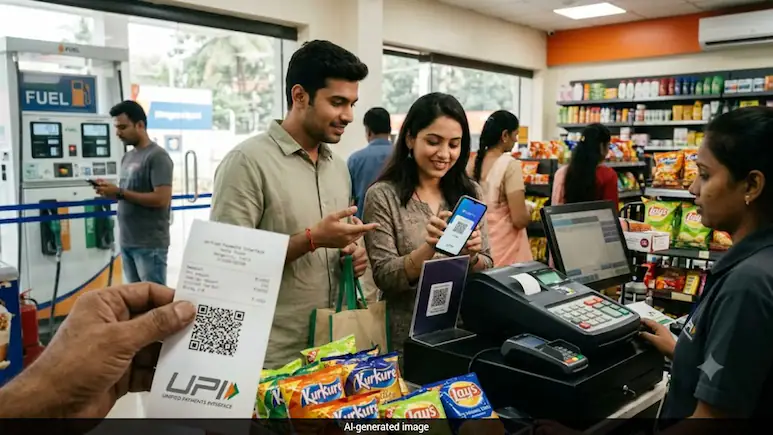
Is the era of free click-and-pay transactions over in India? Yes and no. It depends on who you are and how much money you are sending or receiving. If you are a customer, you pay nothing. It remains absolutely free. There is no exception.
If you are sending money to a friend or any other individual, it remains free. If you are a merchant, you pay a nominal 0.4% charge on receiving above Rs 2,000 in one go, with an upper limit of Rs 300. The charge is fixed at Rs 5 on some transactions like railway ticket booking and fuel payments.
You are shielded if you are an ordinary customer. Your small transactions at the grocery store or fuel pump will see no change. You pay nothing extra. But again, you pay nothing. The seller does, and they cannot make you pay for it. These charges are part of what the National Payments Corporation of India (NPCI) calls the Merchant Discount Rate (MDR) framework for the Unified Payments Interface (UPI). The government argues the money will go to banks and app providers to sustain operations and help expansion. The government doesn’t collect this charge. Neither does the NPCI. This is not a tax. So who does it go to? Let’s take four case studies to understand the impact of the new UPI charges. What do you pay? Nothing, unless you run the petrol pump. The fuel company or the petrol pump operator pays that. As a customer, you pay only for the fuel and get going. You don’t pay the applicable charge. The restaurant pays that. You pay that exact amount. The seller pays this amount. Not you. Will you pay the MDR or your friend who receives the money online? Neither. This counts as a person-to-person transaction, covered under the zero-MDR framework. Now arises the concern: what if the merchants try to pass on the charge to you? You may have already faced that while using credit cards to pay at merchant outlets. “Banks have been advised to ensure that merchants do not pass MDR charges on to customers. UPI application providers are expressly prohibited from imposing platform fees or hidden charges,” the Finance Ministry states. In short, individuals will have unlimited free usage. There is no monthly quota, volume restrictions, or tiered caps on free UPI transactions. The transaction limits are not linked to charges. The government suggests this fund will support wider UPI acceptance, sustained usage, and the inclusion of small businesses in India’s digital payments ecosystem. Larger merchant transactions will pay for it, and the revenue generated will go to banks, payment service providers, and UPI app providers. This will help them expand their services and improve infrastructure in the rural and semi-urban areas.
Therefore, this framework will protect individuals, micro-enterprises, and small businesses, according to the government. If the bill is above Rs 2,000, the merchant pays. Read: UPI Charges To Be 0.4% For Some Payments Above Rs 2,000. Free For Consumers For some transactions, like paying for railway tickets or refuelling, a flat rate of Rs 5 will be applicable for transactions above Rs 2,000. It will become effective from October 15. Case 1: You get your car’s fuel tank filled. The bill shows Rs 5,000. A flat rate of Rs 5 is applicable in this case. Case 2: You dine at a restaurant, and the bill is Rs 6,000. Again, you pay Rs 6,000, and that’s it. At 0.4%, the MDR will be Rs 24. Case 3: You buy a mobile phone that costs Rs 30,000. The MDR is calculated at 120, based on a Rs 0.4% rate. Case 4: A friend asks you to transfer Rs 10,000 for an emergency. Boards are often put up outside shops stating that a 1-2% charge will be applicable if you pay using cards. which generally range from Rs 1 lakh to 5 lakh depending on the transaction category, the government states these are security and risk-management safeguards and not charging thresholds While there are daily transaction limits prescribed by banks and NPCI. The government argues that the Rs 2,000 threshold will keep 96% of all person-to-merchant transactions free. Data suggests that only the remaining 4% of merchant transactions will face the charges. Besides, a dedicated fund will also be established to promote UPI adoption among small merchants, with an amount equivalent to 5% of the total MDR collections contributed to this fund. The MDR framework has been introduced under the Payment and Settlement Systems Act, 2007.
This will be distributed among the payment ecosystem participants, including banks and payment application providers, to support the operation and continued expansion of the UPI ecosystem, the ministry says. The government says this cannot be done while paying using UPI. The government says that it will strengthen the long-term sustainability of UPI while keeping payments free for individuals and protecting small businesses.
