
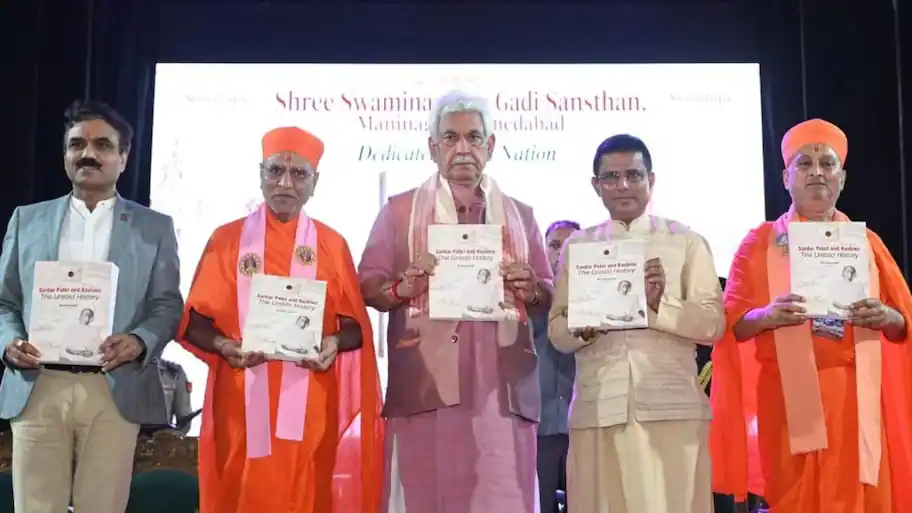
Lieutenant Governor Manoj Sinha on Tuesday launched the book Sardar Patel and Kashmir: “The Untold History”, paying rich tribute to Sardar Vallabhbhai Patel’s foresight and nation-building vision while highlighting newly examined archival material that sheds light on the Iron Man’s deep engagement with Jammu and Kashmir.
Kadri announced that future volumes would examine ideological and policy differences between Sardar Patel and Jawaharlal Nehru on the Kashmir question. Sinha noted that the constitutional change had opened new avenues of education, employment, entrepreneurship, and development for the youth of the region. The book draws extensively on microfilms of the Sardar Papers preserved in the National Archives of India. The archives contain memorandums, personal letters from common people, and even a Tahsildar’s report concerning Kashmir’s integration. Dr. Rizwan Kadri, the book’s editor, shared that the idea for the work took shape during a recent visit to Lal Chowk in Srinagar. He explained that original papers had been destroyed in floods, but microfilms from the National Archives enabled the reconstruction of the historical record. He expressed regret that no major institution in Kashmir currently bears Patel’s name despite his central role in the region’s integration, and he formally demanded that the Chenab Railway Bridge be renamed the “Sardar Patel National Integration Chenab Railway Bridge. In his address, Lieutenant Governor Sinha outlined four priorities for Jammu and Kashmir’s future: zero tolerance toward terrorism to ensure lasting peace; rapid development through infrastructure and connectivity; empowerment of youth by linking them to India’s digital economy and startup ecosystem; and the revival of cultural heritage to strengthen tourism and human values.
These documents reveal that Patel was in direct contact with people and institutions in Kashmir as early as 1946. Speakers at the event underlined the significance of the Praja Mandal movement launched by Patel in 1935 and the subsequent role of the Praja Parishad in Jammu and Kashmir, which acted as a vital bridge between ordinary citizens and the national leadership. He also pointed to Mahatma Gandhi’s visit to the region in early August 1947—his arrival in Srinagar on August 1, a full day spent with Maharaja Hari Singh on August 3, a stay in Jammu on August 4, and a public address at a Gurudwara in Jammu on August 5—as important missing links now brought into public view.
Speaking at the launch, the Lieutenant Governor described Sardar Patel as the “architect of modern India,” whose practical wisdom and indomitable will integrated 562 princely states into a united nation. He recalled Patel’s firm declaration that “we will not give even an inch of Jammu and Kashmir’s territory to anyone” and said the abrogation of Articles 370 and 35A in August 2019 under Prime Minister Narendra Modi fulfilled Patel’s unfinished dream of complete integration. Kadri said the documents show Patel’s sustained outreach to the people of Kashmir and the pivotal contribution of the Praja Parishad.
