
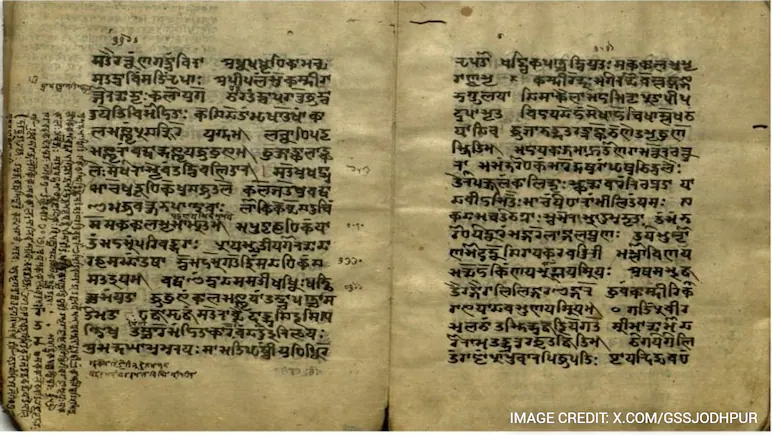
India’s rich documentary and intellectual heritage has received significant international recognition, with three of its most influential historical and literary works, the Mahabharata, Arthasastra, and Rajatarangini, inscribed on UNESCO’s Memory of the World Committee for Asia and the Pacific (MOWCAP) Regional Register.
Union Minister for Culture and Tourism Gajendra Singh Shekhawat welcomed the announcement, describing the inclusion as a moment of immense pride for the country and a landmark recognition of India’s extraordinary documentary and civilisational heritage. The Arthasastra, traditionally attributed to Kautilya, also known as Chanakya, is a foundational work on governance, administration, economics, diplomacy and military strategy. Its detailed examination of statecraft, taxation, law enforcement, intelligence networks and public administration offers valuable insights into political organisation and the functioning of ancient Indian states. The text remains an important reference for scholars studying the history of political and economic thought. It facilitates nominations, promotes archival awareness, supports manuscript conservation and organises capacity-building programmes.
The latest inscriptions also highlight India’s growing engagement with UNESCO’s Memory of the World Programme, which was launched in 1992 to protect documentary heritage against loss, deterioration and collective amnesia. India’s participation in the initiative is coordinated by the Indira Gandhi National Centre for the Arts (IGNCA), designated as the country’s nodal institution in 2014.
In a post on X, the minister said the three works represent India’s longstanding traditions of historical inquiry, philosophical thought and statecraft, adding that their wisdom continues to inspire humanity.
The programme seeks to ensure that historically and culturally significant documents remain preserved and accessible to future generations.
