
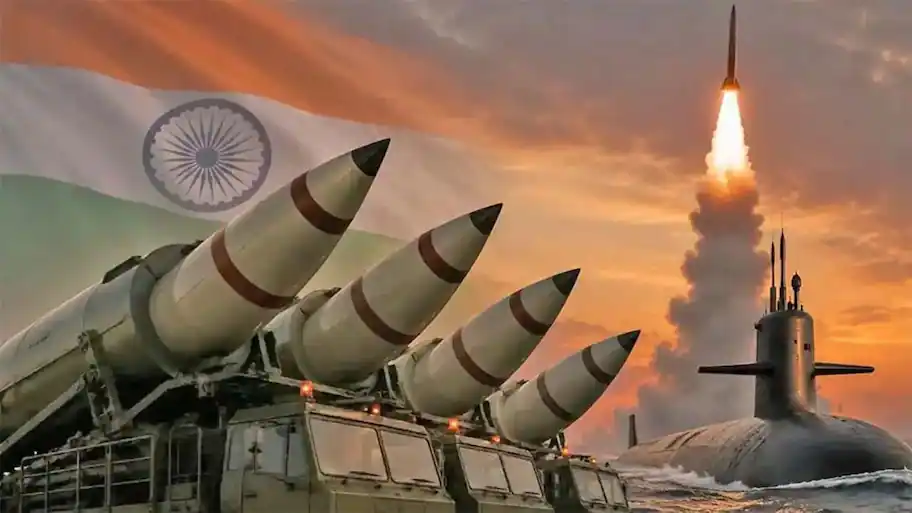
New Delhi: India has built a nuclear force that can deliver weapons by air, land and sea, reveals the Bulletin of the Atomic Scientists. The report estimates that India has assembled up to 190 nuclear warheads and now operates nine nuclear-capable delivery systems.
The systems include fighter aircraft, land-based ballistic missiles and submarine-launched missiles. The report says the missile can potentially reach most of China when launched from parts of India. The Agni-V is also stored and launched from a sealed canister. This allows the missile to be transported and launched from its mobile platform without being exposed in the open.
Authored by Hans M. These three systems give India a nuclear triad (the ability to launch nuclear weapons from land, air and sea). India does not disclose the size of its stockpile or the exact operational details of its strategic weapons. The Agni missile family is the main land-based component of India’s nuclear force. The report identifies six operational nuclear-capable ballistic missile systems – Prithvi-II, Agni-I, Agni-II, Agni-III, Agni-IV and Agni-V. The Agni-P is also nearing operational deployment. The estimated ranges increase across the series. That range gives it a different role from India’s shorter-range missiles. Its longer reach also allows India to place launch units farther from the Chinese border. The Agni-V also has a distinctive technical feature. It has been tested with Multiple Independently Targetable Re-entry Vehicle (MIRV) technology. The system allows a missile to carry multiple payloads that can be directed towards separate targets. India’s nuclear force also includes aircraft. The Mirage 2000H is assessed as the country’s main nuclear strike aircraft. The Bulletin estimates that some its squadrons are assigned nuclear missions involving Pakistan and China. The Jaguar is also believed to have a secondary nuclear role. India has operated the aircraft since the 1980s, though the Air Force has plans to retire older Jaguars over the coming years. The Rafale could eventually take over part of the nuclear role now given to the Jaguar. The researchers say France uses the Rafale for nuclear missions. They say India could potentially adapt the aircraft for a similar role in the future. This gives the country an air-based option along with its ballistic missiles. Aircraft also offer a different type of delivery platform, with the ability to be deployed from air bases and used as part of a flexible strike force. India has also strengthened its sea-based nuclear force. The INS Arihant was the first. It is larger than the first two boats and is believed to have eight missile tubes. India is also building additional submarines. Submarines give nuclear forces a sea-based option that can operate away from fixed land positions. This is important for a second-strike capability. A submarine that survives an initial attack can provide a platform for retaliation. The three components give the country several ways to deliver nuclear weapons and make its nuclear force less dependent on any single platform.
Because of its payload and the weight of India’s existing warheads, the researchers estimate that the missile could carry a small number of warheads. India’s nuclear triad therefore now includes aircraft, land-based missiles and submarine-based missiles. Agni-I can travel about 700 km, Agni-II more than 2,000 km, Agni-III over 3,200 km and Agni-IV more than 3,500 km. The Agni-V is assessed as having a range of less than 6,000 km. India first announced an Agni-V MIRV test in March 2024 under Mission Divyastra. Another test took place in May 2026. The INS Arighaat followed in 2024. The third submarine, INS Aridhaman, was commissioned on April 3, 2026. The fourth Arihant-class boat, INS Arisudan, is scheduled for commissioning in 2027, according to the report.
Kristensen, Matt Korda, Eliana Johns and Mackenzie Knight-Boyle, the report says India is upgrading its nuclear arsenal. The report says there is limited public information about the country’s nuclear arsenal. The missile ranges available in public sources are estimates and may not show the full capability of some systems, the authors said. The Bulletin says more testing is likely needed before the capability can be considered fully operational. The country now has three nuclear-powered ballistic missile submarines, according to the study.
No first use policy
India continues to describe its nuclear posture in terms of credible minimum deterrence and a ‘No First Use’ policy. The ability to deliver nuclear weapons from aircraft, mobile missiles and submarines gives the country options for retaliation if it suffers a nuclear attack. The report examines India’s security situation with Pakistan and China. The estimate is based on public information, satellite images, government statements and other available evidence. The exact size and deployment of the nuclear arsenal are not publicly known. The country’s nuclear force includes aircraft, long-range ballistic missiles and nuclear-powered ballistic missile submarines. The Agni-V, MIRV technology and newer SSBNs are part of this nuclear capability.
The purpose of the three-part delivery system is therefore based on India’s stated deterrence policy. The Ministry of External Affairs said in 2025 that India follows its No First Use policy and will not use nuclear weapons against countries that do not possess them. It also refers to the missile strikes during Operation Sindoor in 2025 that was launched after the deadly Pahalgam terror attack. The Bulletin estimates that India has up to 190 nuclear warheads.
Chief of Defence Staff General Anil Chauhan also described the country’s nuclear doctrine in 2024 as being based on “No First Use & Massive Retaliation”.
