
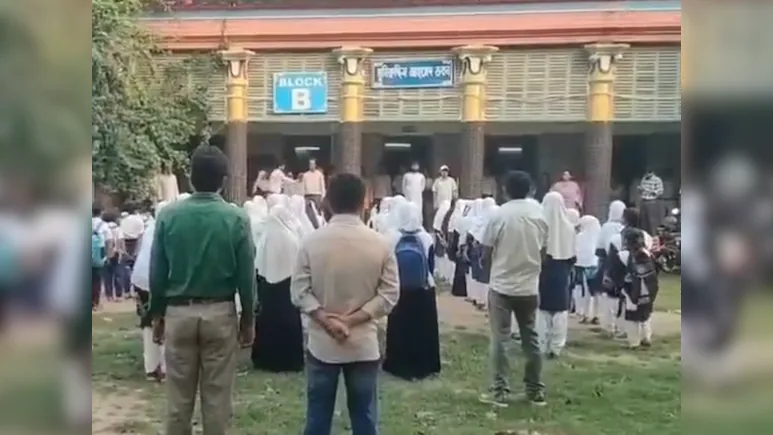
Islampur in Uttar Dinajpur and Haripal in Hooghly: These are two recent examples of what are being described as illegal madrasas in West Bengal. Reports suggest that no classes are held there, no functioning school, and no teachers. In Haripal, one such madrasa has virtually turned into a large banana plantation. In Islampur, government permission for the structure was reportedly granted several years ago, but the building now stands like an abandoned house. Who comes there, why they come and what actually happens inside remains unknown.
Now Chief Minister Subhendu Adhikari has ordered that the madrasas operating in Bengal be reviewed and that those which are illegal be identified. The exercise will look at which institutions are legal and which are not, what is being taught there and what activities are taking place. Following an intelligence report, Union Home Minister Amit Shah has raised concern, particularly about madrasas in border districts. The allegation is that Bangladesh is being used as a route for Pakistani militants to enter Bengal and the border areas are being used for training. When Buddhadeb Bhattacharjee was Chief Minister, he too had acknowledged that such a problem existed in West Bengal. He also identified four Muslim-dominated districts in Assam.
In 2002 and 2003, Buddhadeb Bhattacharjee became particularly active in taking action against illegal madrasas. On November 8, 1998, Lieutenant General SK Sinha – who was the Governor of Assam from 1997 to 2003 and had earlier served as Vice Chief of Army Staff – submitted a 42-page report to then President KR Narayanan and Home Minister LK Advani. In it, he described how Bangladeshi infiltrators had entered Assam after 1971 and how a section of them was becoming involved in militant activities. The Muslim population had grown by 77.42 per cent after 1971, while the Hindu population had increased by 41.89 per cent, according to the figures cited in the report.
Standing in the West Bengal Assembly, he had said a section of madrasas in the border districts had become a breeding ground for terrorism.
In Bengal, there are three categories of madrasas. One category consists of government-aided institutions, where the government provides support and pays teachers. The third category comprises private, unregistered madrasas, which operate on donations.
There are around 614 to 628 such madrasas. The second category consists of around 601 registered but unaided madrasas.
