
Written by Anil Chaudhary
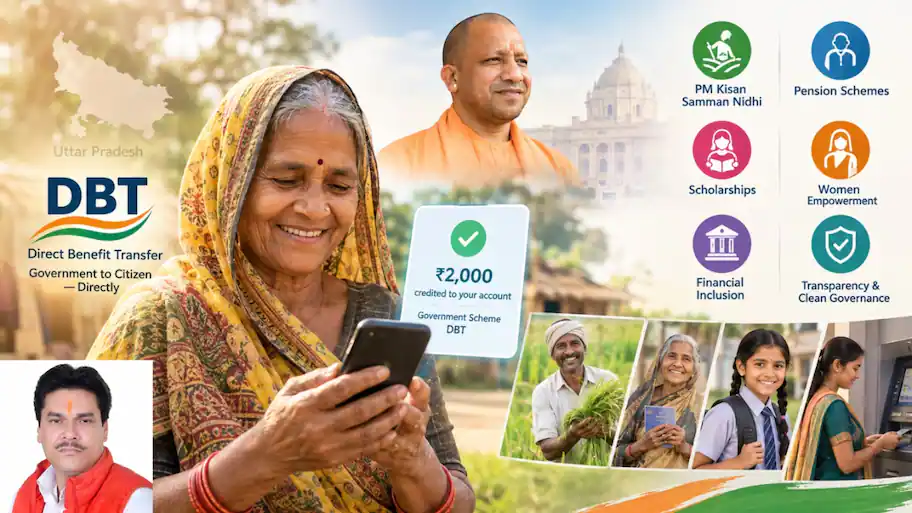
Until a decade ago, Uttar Pradesh faced the paradox that funds for schemes would be released from the capital but would disappear somewhere along the way. Antyodaya does not merely mean that government assistance reaches the last person. The real test is whether it reaches them with dignity. For years, elderly women in villages kept making rounds of government offices for their pensions, farmers stood before clerks to claim their rightful dues, and poor people had to seek someone’s recommendation at every stage. Even when assistance arrived, it came in the form of a favour. DBT has changed this very picture in Uttar Pradesh. Now, money transferred from Lucknow or Delhi goes directly into the beneficiary’s account, with no middleman and no deductions in between. Instead of having to hold out their hands in supplication, people can now claim their rights with confidence. Assistance is not charity but an entitlement, and the Yogi government has translated Pandit Deendayal Upadhyaya’s vision of Antyodaya into a reality on the ground in precisely this form. Files moved, signatures were made, announcements echoed, and the very person in whose name the entire exercise was undertaken often remained empty-handed at the very end of the queue. Pandit Deendayal Upadhyaya had stated that the success of a system, within the concept of Antyodaya, should be assessed on the basis of how sincerely the benefits of schemes reach the person standing at the last rung of society. Judged by this criterion, the expansion of Direct Benefit Transfer, or DBT, in Uttar Pradesh represents something far beyond an ordinary reform. DBT has changed the equation that portrayed a deprived person as a supplicant who needed someone’s recommendation or the support of middlemen to receive anything from the government. Built on the trinity of Jan Dhan accounts, Aadhaar and mobile phones, this system has almost eliminated the distance between the government and the citizen. A button is pressed in Lucknow, and money reaches the account of an elderly woman sitting in a village hundreds of kilometres away. No slip, no bag of cash, no favour. The significance of this system becomes evident when one considers its reach in a state whose population is larger than that of many countries. Carrying out this work on such a large scale has been possible only through the combination of technology and political will. There is one aspect of this change that figures cannot fully capture, and that is dignity. When an elderly woman does not have to hold out her hand before anyone to receive her pension, and a labourer does not have to make repeated visits to a political leader to obtain assistance, the relationship between the government and the citizen becomes one of entitlement and accountability. A citizen who trusts that their rightful dues will reach them without any recommendation begins to regard the system as their own. This trust is the greatest asset of good governance. Good governance is not a distant ideal; it is something experienced in everyday life. The model established by Uttar Pradesh under the leadership of Chief Minister Yogi Adityanath demonstrates that when political will and administrative commitment work together, technology can become a powerful instrument of public welfare. It also resonates with Prime Minister Narendra Modi’s mantra of Sabka Saath, Sabka Vikas, Sabka Vishwas and Sabka Prayas, which identifies these principles as the foundation of governance. DBT has made a concrete beginning in this direction. The role of middlemen has diminished, leakages have been curbed, payments have begun to arrive on time, and citizens have moved from being supplicants to rightful claimants. (The author is a National President of Jat Mahasabha. The views expressed in this article are those of the author and do not necessarily reflect those of Zee News.)
Nearly 200 Central and State Government schemes have been linked to this framework. More than 900 million beneficiaries are covered under it, and several lakh crore rupees have so far been transferred directly into their accounts.
