Pargat Singh takes charge of the Punjab Congress with one of the party’s biggest challenges – managing an organisation where several senior leaders have their own political ambitions and competing support bases. His appointment comes at a time when differences among various camps have repeatedly surfaced within the state unit.
Pargat Singh is not new to party organisation. He has served as Punjab Congress general secretary (organisation)
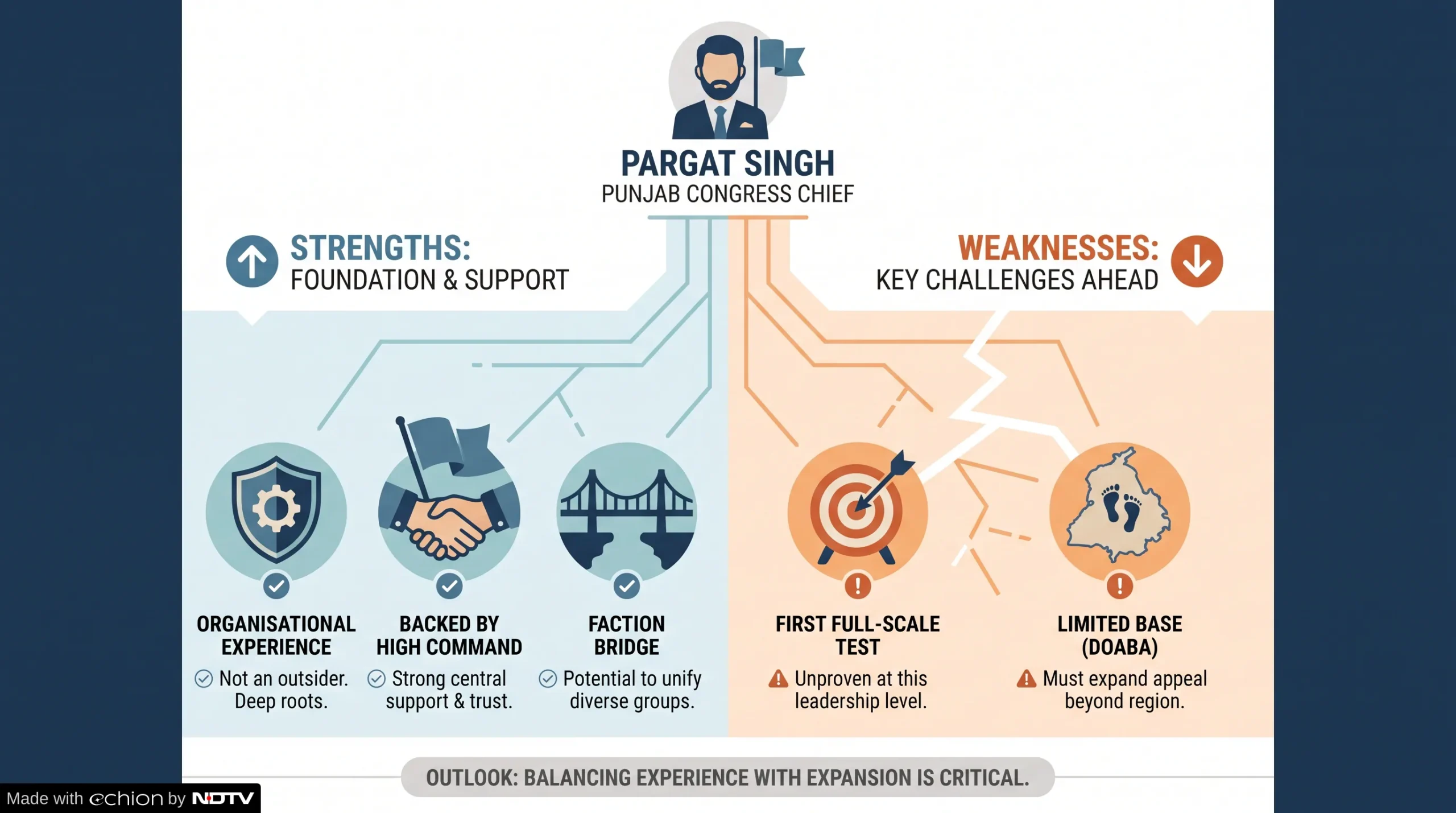
Pargat is not new to party organisation. He has served as Punjab Congress general secretary (organisation), apart from being a three-time Jalandhar Cantt MLA and former cabinet minister. More importantly, he enters the post with a relatively independent political identity, allowing him to engage with different camps. Pargat’s political positioning could be particularly useful in a Congress where senior leaders have often followed different political and organisational lines. He has maintained political equations with leaders across different groups but has not emerged as the organisational face of any one major faction. This gives him an opportunity to play a bridge-building role – maintaining communication with Charanjit Singh Channi, Sukhjinder Singh Randhawa and Partap Singh Bajwa while also reaching out to leaders associated with Raja Warring’s organisational network. The challenge will be to keep these competing groups engaged without allowing the PPCC to become another battleground for factional politics. Pargat will have to deal with a Congress where the leadership question goes beyond the PPCC post. Several senior leaders have their own political ambitions and support bases in Punjab. His task will be to give space to these leaders without allowing competing ambitions to turn into competing organisations. this is his first stint as president of the Punjab Congress Although Pargat has organisational experience. The PPCC chief’s responsibility is considerably broader – managing district units, ticket aspirants, senior leaders, election committees and grassroots workers while coordinating the party’s statewide campaign. His challenge will be to establish authority without creating another round of organisational disruption. Another immediate challenge will be handling the organisational structure created during Raja Warring’s tenure. Warring had worked extensively on district-level organisation and appointed or reshaped district presidents. Many of these leaders have their own local equations and political networks. Pargat will have to decide where continuity is required and where organisational changes are necessary. Any major reshuffle could create resentment, while retaining the entire structure could limit his ability to establish his own organisational authority. For Pargat Singh, the transition is significant – from being a leader who questioned powerful political establishments to becoming the leader who has to bring powerful leaders together. His organisational experience and relatively independent political image give him space to attempt that role.
His challenge will therefore be to move beyond his Doaba base and build strong organisational equations across Malwa, while also managing the party’s leadership dynamics in Majha and Doaba. He will need to establish himself as a coordinator who can bring different leaders onto a common platform for the 2027 campaign, rather than becoming another factional power centre. Pargat’s political base is in Doaba, which has 23 assembly seats. But Malwa, with 69 of Punjab’s 117 assembly constituencies, remains central to the state’s electoral politics. But the real test will be whether he can manage competing ambitions, maintain organisational discipline, retain the existing grassroots network where necessary and build a bridge between Punjab Congress’s rival factions ahead of the 2027 assembly polls.
His earlier experience gives him an understanding of the party’s organisational structure and grassroots functioning.