
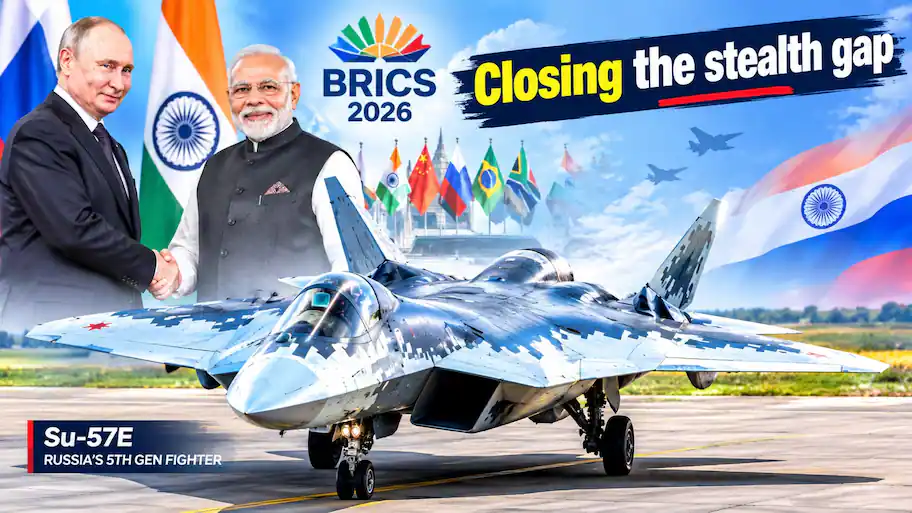
Russia is aggressively pitching the Su-57E fifth-generation stealth fighter to New Delhi, pairing the sales offer with comprehensive technology transfers, joint production frameworks, and source code access. Discussed prominently during bilateral meetings at the BRICS summit between President Vladimir Putin and Prime Minister Narendra Modi, the aircraft is positioned as an immediate stopgap measure to counter regional rival advancements until India’s indigenous Advanced Medium Combat Aircraft (AMCA) enters service around 2035.
Facing a critical squadron deficit and mounting stealth threats along its borders, the Indian Air Force is carefully weighing the strategic advantages of acquiring foreign fifth-generation tech against domestic manufacturing priorities. Strategic urgency : Procuring an interim fleet of Su-57E jets allows India to immediately counter two-front operational pressures without waiting a decade for indigenous programs to mature. Operational integration : A limited initial buy allows pilots and maintenance crews to master fifth-generation tactics, sensor fusion, and stealth upkeep protocols. Advanced flight metrics : The Su-57E offers front-end stealth, super-maneuverability, thrust vectoring, and advanced sensor fusion suited for both air superiority and strike missions. Moscow’s willingness to share engine technologies and source code provides unique leverage for India’s domestic defense manufacturing ecosystem. Boosting Make in India : Co-production opportunities give Indian aerospace engineers hands-on experience with radar-absorbent stealth coatings, advanced avionics, and weapon integration. Weapon customisation : The framework opens the door to integrating indigenous munitions, such as the Astra missile series, reducing foreign dependencies. Despite immediate tactical gains, critics point to valid concerns regarding international sanctions, supply chain vulnerabilities, and potential distraction from indigenous timelines. Sanction and production risks : Ongoing international restrictions on Russian manufacturing could introduce severe supply chain bottlenecks for spare parts and long-term fleet maintenance. Diluting local focus : Pouring billions of dollars into a foreign platform risks drawing political and financial capital away from the indigenous AMCA initiative. Strategic autonomy : India must balance its immediate need for regional air dominance with its long-term objective of achieving complete defense self-reliance.
Because the IAF already operates a massive fleet of Su-30MKI fighters, shared maintenance philosophies and pilot training overlaps could streamline integration, logistical familiarity :. India’s fighter squadron strength currently sits at roughly 29 units against an authorized requirement of 42, exacerbated by the steady retirement of legacy airframes. Regional rival capabilities : China continues to deploy large numbers of J-20 stealth fighters near Tibet, while Pakistan moves toward acquiring advanced Chinese J-35A platforms. The capability gap : While the IAF operates formidable 4.5-generation assets like the Rafale, Su-30MKI, and Tejas, none possess true radar-evading stealth architecture required to penetrate modern integrated air defense systems. Defence experts suggested that procuring two to four squadrons—translating to approximately 36 to 80 aircraft—would provide the optimal balance for immediate operational readiness. Resource equilibrium : Keeping the initial foreign procurement sized between 36 and 60 units ensures state funds and engineering talent remain heavily concentrated on the domestic AMCA roadmap.
