
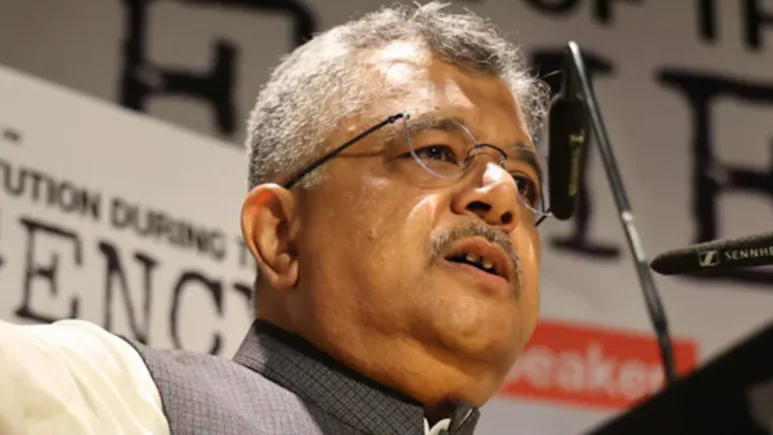
Senior advocate S Muralidhar, who was arguing the petition filed by singer TM Krishna, took strong offence to the use of the word, but Solicitor General Tushar Mehta refused to withdraw his comment.
The use of the word “Naxalites” by the government’s lawyer ignited a confrontation in the Supreme Court on Tuesday during the hearing of a challenge to the recent legal amendment that makes not singing Vande Mataram a penal offence.
This is going live. Let him repeat! This was unnecessary. Some decorum is to be observed. We don’t expect this from law officers. Mehta remained steadfast. One has to go by law. The exchange aside, the court in its order sought the Centre’s response to the petition. The centre’s ruling BJP has liberally deployed it to attack political adversaries via social media and speeches. Since the National Song is understood as the first two stanzas, the government issued a separate order making all six stanzas mandatory. Krishna has also challenged the Ministry of Home Affairs’ directions requiring all six stanzas to be sung at specified government, ceremonial and cultural occasions. Krishna’s argument aligns with some contentions made during the Independence movement that the latter four stanzas of the song expressly invoke devotion to Hindu deities.
As for the exchange in the SC, it came as Carnatic singer TM Krishna has challenged the amendment made earlier this year to Section 3 of the Prevention of Insults to National Honour Act, 1971.
“Law-making should not be [as per] Naxalites,” Mehta had remarked, after Muralidhar argued that a top-down approach to law-making was not appropriate. Muralidhar, who is a former high court judge , immediately said, “He should withdraw this. “I can repeat what I said. I am not sorry about what I said,” he told the bench of Chief Justice of India Surya Kant and Justices Joymalya Bagchi and V Mohana. The words Naxalite and Naxal or Maoist, used for left-wing extremism, have been a major part of the government discourse, more so after Prime Minister Narendra Modi used the term “Dimagi Naxal” for those who allegedly further the ideas behind such extremism. The amended provision makes it punishable with imprisonment of up to three years to intentionally prevent the singing of the National Anthem (Jana Gana Mana) “or the National Song” Vande Mataram. He said mandating their singing violates the secular character of the nation, and thus the amendment furthers a “majoritarian religious message”.
To the extent of penal consequences [we will examine], but declaration as national song, courts can’t dictate. CJI Kant remarked, “If someone reads history, they will know what is National Song. After the order was dictated, S Muralidhar raised the remark again. Muralidhar reacted, “He is again repeating. Now I have to register strong protest!. He accused Mehta of playing to the gallery. Justice Bagchi further observed that calling someone a Naxalite did not strip them of their constitutional rights as such While CJI Kant asked the counsels to save their arguments for the next date. “My intention was that legislative decision-making is constitutional.
Because of their religious beliefs, in that landmark case, the SC protected schoolchildren who stood respectfully during the National Anthem but did not sing it. In observations during the hearing, Justice Bagchi said the bench expected the 1986 judgment in ‘Bijoe Emmanuel v State of Kerala’ to govern the amended law.
Arguing for Krishna, Muralidhar argued that the amendment was brought in hastily, without any attempt to build broad national consensus, and said the original law did not mention “national song”. At this, Justice Bagchi said, “National Song has always been understood as Vande Mataram… Justice Bagchi said the bench was confining itself to the constitutional issue. Mehta then repeated the remark and said he was not sorry. Mehta later said he was referring to an ideology and was not labelling any individual. It cannot be done by arms etc.,” he said.
