
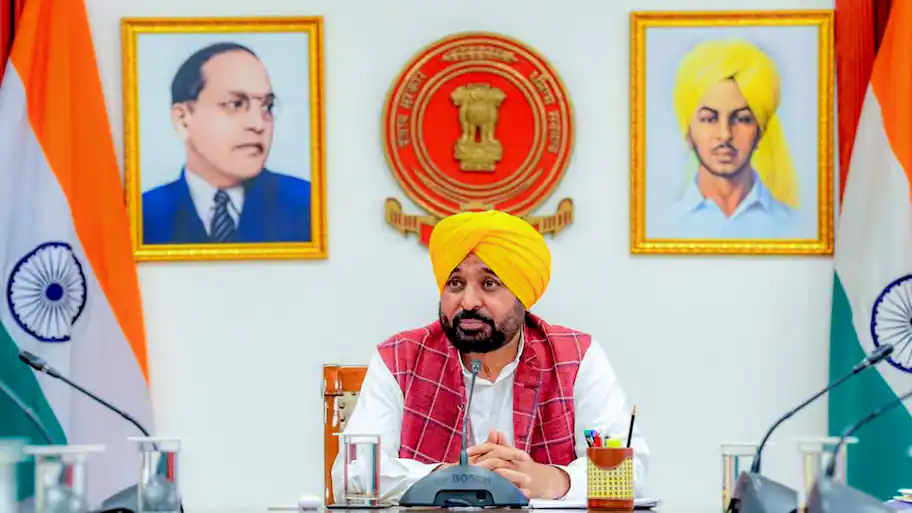
Punjab Chief Minister Bhagwant Singh Mann on Sunday said Sri Akal Takht Sahib is “supreme for all of us” and asserted that his government will ensure the strongest possible legal framework to protect the sanctity and dignity of Sri Guru Granth Sahib Ji.
Mann directed the seven-member committee to hold detailed and regular meetings with the panel constituted by Sri Akal Takht Sahib, consider its suggestions and work towards consensus on proposed amendments. He stressed that the law must continue to provide the strongest possible protection to the sanctity of Sri Guru Granth Sahib Ji while addressing legal and constitutional concerns. “While discussing the provisions of the law with the panel constituted by Sri Akal Takht Sahib and working towards building consensus, the spirit and core objective of the law must not be compromised. “There is no doubt that this law has provided solace to the deeply hurt sentiments of the Sikh Sangat, which has been perturbed over frequent incidents of sacrilege. The committee will hold detailed consultations with the panel constituted by Sri Akal Takht Sahib and examine every aspect of the law before providing guidance to the state government. He added that he had directed nodal officer and PCS officer Harjit Singh Sandhu to ensure complete coordination for future meetings and provide all necessary assistance to the committee. “Sri Akal Takht Sahib is supreme for all of us, and I consider myself fortunate to have had the opportunity to serve by framing a stringent law to prevent incidents of sacrilege. Mann reiterated that the government was committed to framing a strong law prescribing the strictest possible punishment for anyone who commits sacrilege. Mann expressed hope that the committee’s deliberations would result in an outcome in keeping with the sentiments of the Sikh Panth and further strengthen the legal framework for protecting the sanctity of Sri Guru Granth Sahib Ji. Members of the seven-member high-level committee who attended the meeting were former Jathedar of Sri Akal Takht Sahib Giani Raghbir Singh, Baba Sahib Singh representing Damdami Taksal, Sant Baba Sewa Singh Rampur Khera, Justice (Retd.) Jaspal Singh, Justice (Retd.) Gurbir Singh, IPS (Retd.) Jatinder Singh Aulakh and Law Officer Preet Inder Pal Singh. Head of Damdami Taksal Sant Giani Harnam Singh Khalsa joined the meeting online. Director, Punjab Bureau of Investigation LK Yadav, Advocates GS Ghuman and GPS Ghuman, along with other senior officers, were also present at the meeting.
The provisions prescribing life imprisonment and heavy fines for perpetrators of sacrilege constitute the core foundation of this law, and therefore the law must not be weakened at any cost,” Mann said. Mann said he had asked the committee members to initiate a series of meetings with the Sri Akal Takht Sahib panel so that necessary amendments, if required, could be taken forward through mutual consultation and consensus. The Chief Minister said the government had chosen to amend the existing law instead of introducing entirely new legislation so that the amended law could be sent to the Governor for approval.
The meeting, held at the Chief Minister’s residence, focused on the provisions of the Jaagat Jot Sri Guru Granth Sahib Satkar (Amendment) Act, 2026, concerns raised over certain provisions and the way forward through consultation and consensus. He added that certain concerns had been raised regarding provisions of the Jaagat Jot Sri Guru Granth Sahib Satkar (Amendment) Act, 2026, and that the government was willing to examine them in their entirety.
At a detailed meeting with a seven-member high-level committee constituted by the state government, Mann said life imprisonment and heavy fines for perpetrators of beadbi (sacrilege) form the core foundation of the law and cannot be diluted. The Chief Minister said the legislation had provided solace to the “deeply hurt sentiments” of the Sikh Sangat, which, he said, had been perturbed by frequent incidents of sacrilege. For the first time, a strong sense of deterrence is being created among those who may contemplate committing such a heinous offence,” he said. Mann said the government’s objective was to prescribe the strictest possible punishment for those found guilty of sacrilege and ensure that no person would dare to commit the offence. The state government constituted a seven-member committee comprising personalities associated with the religious sphere, intellectuals and legal experts, according to Mann. “The proposed amendments will be discussed comprehensively so that an amicable resolution can be arrived at after taking into consideration all legal, constitutional and other relevant aspects,” Mann said. Our government will approach this entire process with the utmost respect and sensitivity,” Mann said. He said the Bill had been drafted after extensive consultations with legal experts, with the objective of ensuring that there were no loopholes that could undermine its effectiveness in the future. “Whenever an incident of sacrilege takes place, it causes deep anguish to the collective conscience and sentiments of the people, and this cannot be tolerated at any cost,” he said. “Our intention is to ensure that the legal framework remains strong and effective while addressing every legitimate legal and constitutional concern,” he said. He said incidents of sacrilege witnessed in the past had deeply hurt the sentiments and psyche of the Sikh Sangat and stressed that protecting the sanctity and dignity of Sri Guru Granth Sahib Ji was a collective responsibility. “We fully respect the sentiments associated with Sri Guru Granth Sahib Ji and will leave no stone unturned to ensure that the law provides the strongest possible framework against sacrilege,” Mann said. He added that the proposed amendments would be taken forward with “utmost sensitivity and responsibility”, strictly in accordance with constitutional and legal principles. “The objective of the state government is clear: the sanctity of Sri Guru Granth Sahib Ji must remain fully protected and the law must effectively fulfil its intended purpose,” he said.
