
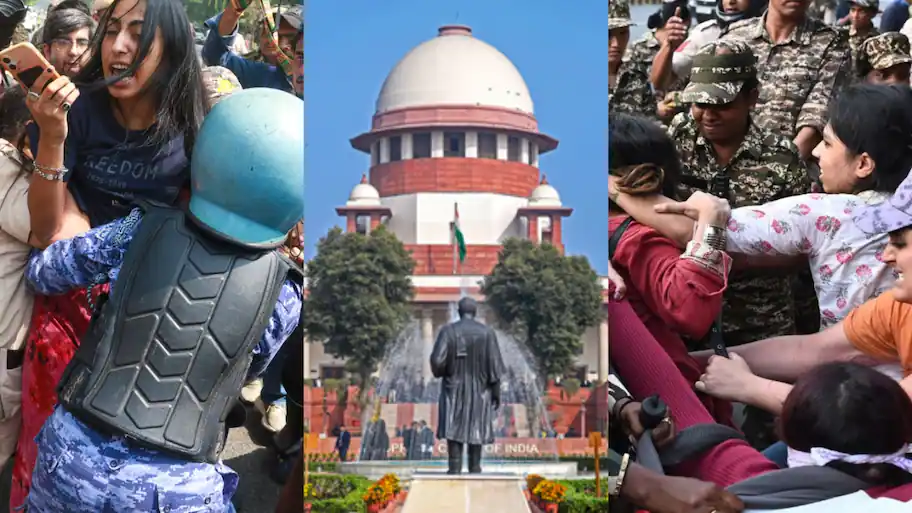
The Supreme Court on Sunday directed authorities to ensure normal Delhi Metro and railway services, uninterrupted internet access and free movement of people and traffic amid protests by the Cockroach Janta Party (CJP).
The court also said peaceful protesters must not be detained except in accordance with the law and ordered a review of barricades, stressing that access to justice must remain unhindered.
Dhruv Rathee was also released in the early hours of Sunday. As per media reports, most people detained during Saturday’s demonstrations had been released that night. On Friday, a three-judge bench headed by Chief Justice of India Surya Kant had questioned the extent of the restrictions. Cockroach Janta Party (CJP) leaders Abhijeet Dipke, Ashutosh Ranka, and Saurav Das were released on Sunday after being produced before an Executive Magistrate. However, shortly after their release, the CJP announced another planned march towards Jantar Mantar on Sunday, maintaining that its protests would continue until its demands are met.
A special bench comprising Justices Joymalya Bagchi and V Mohana heard petitions challenging restrictions and detentions linked to the Cockroach Janta Party’s (CJP) protests against Chief Election Commissioner Gyanesh Kumar. It also emphasised that the movement of people and road traffic should be allowed, subject to lawful restrictions where necessary. The bench further made clear that people peacefully assembling should not be subjected to illegal detention. It indicated that restrictions should not unnecessarily interfere with ordinary public life or prevent citizens from accessing essential services. Mobile internet access was also suspended in parts of central Delhi. Delhi Police had refused permission for the demonstration, citing security concerns and inadequate notice. Barricades were erected across parts of the capital, while police and paramilitary personnel were deployed to prevent large gatherings. Thousands of people were detained. Among those detained were CJP founder Abhijeet Dipke and senior leaders Ashutosh Ranka and Saurav Das were taken into custody after their flight landed at Delhi airport. YouTuber Dhruv Rathee was also detained from Gurugram. Opposition figures including Arvind Kejriwal, Mamata Banerjee and Pinarayi Vijayan were among those detained during the protests. Lawyers, student leaders, activists and journalists also faced police action. The latest protests centre on allegations of irregularities in the Election Commission’s Special Intensive Revision (SIR) of electoral rolls. The CJP and several opposition parties accuse the Election Commission of conducting the voter-list revision in a manner that could exclude legitimate voters. They have questioned large-scale deletions and demanded accountability from Chief Election Commissioner Gyanesh Kumar.
The court also called for the removal of a board displaying an order under Section 163 outside the Supreme Court, saying the measure was necessary to ensure there was no apprehension or confusion about access to justice. Sunday’s special hearing followed complaints that authorities had failed to comply with the Supreme Court’s October 9 directions against a complete shutdown of Metro and railway services ahead of the CJP demonstration. Despite those observations, entry and exit at 45 Delhi Metro stations were restricted on Saturday, while hundreds of railway services were cancelled or disrupted. The legal proceedings followed a major security operation on October 10, when the Cockroach Janta Party and supporting organisations attempted to assemble at Jantar Mantar to demand the resignation of Chief Election Commissioner Gyanesh Kumar. As per media reports, police had held more than 7,000 people. However, CJP has claimed that over 15,000 people were detained. Opposition parties have also planned further demonstrations against alleged irregularities in the electoral process, with the INDIA bloc preparing another mobilisation in Delhi on October 12.
The court said Metro and railway services should operate normally, while internet facilities should remain available in accordance with the law. The court said security agencies could regulate services according to the circumstances but should avoid blanket prohibitions that unnecessarily disrupted public life. Their release was subject to the condition that they sign a one-year peace bond, according to CJP legal head Ratna Singh.
The Election Commission has denied favouring any political party and maintains that differences of opinion during internal deliberations are normal. The BJP has also rejected allegations of electoral manipulation. The controversy intensified after a September 23 investigation by The Indian Express reported that two election commissioners had raised internal objections to several decisions concerning electoral-roll revisions and related procedures.
