
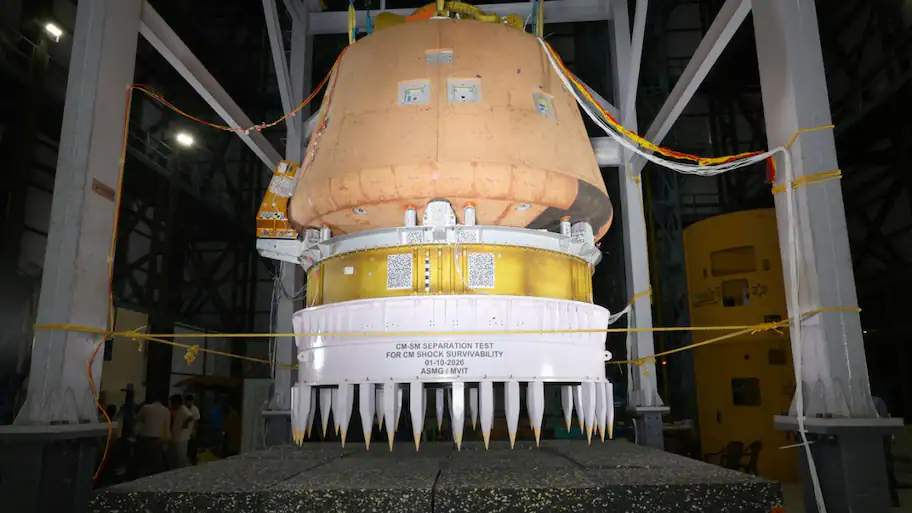
Somewhere high above the Earth, at the end of India’s first human spaceflight, a quiet but decisive moment will unfold. The capsule carrying our astronauts will have to let go of the companion craft that has kept it alive for the entire journey, cleanly, in a precise sequence, with no second chances. Every step of that farewell has now been rehearsed on the ground, and the Indian Space Research Organisation says the results give it fresh confidence ahead of Gaganyaan-1, the uncrewed test flight scheduled for 2026.
Picture the Gaganyaan spacecraft as two parts travelling together. One is the Crew Module, the cone-shaped capsule where the astronauts sit. The other is the Service Module, which sits behind it and acts like a power plant and supply room rolled into one, providing electricity, fluids, and other support. The two are joined together before launch and fly as a single body through the climb into space and all through the on-orbit phase, the stretch of time when the spacecraft circles the Earth carrying out its planned work before turning for home. A moment like this cannot be left to hope. If a cable fails to cut, or if the force of separation damages something inside the capsule, the astronauts’ return could be endangered. That is why ISRO built a dedicated test facility at the Vikram Sarabhai Space Centre in Thiruvananthapuram. It was designed to reproduce the conditions of the complete Crew Module and Service Module assembly, with a range of advanced measuring instruments to watch and record every detail of how the system behaves. Each of these systems guards the crew in its own way. The avionics are the electronic brains of the spacecraft. They control it and keep watch over it. The inertial navigation systems are its sense of direction. They tell the capsule where it is, which way it faces, and how fast it is moving. The Thermal Protection System is its armour. Fitted to the rear and cone-shaped heat shields, it keeps the searing heat of re-entry away from the astronauts. Then there is the Crew Module Deployable Umbilical Shield, a protective cover that closes over the spot where the cables and pipes once connected. Two further systems also depend on pyrotechnic devices. The first is the Crew Module Uprighting System. After the capsule splashes down in the sea, this system turns it the right way up so the crew is not left tilted in the water. The second is the thermal and humidity control system, which keeps the air inside the cabin at a comfortable temperature and moisture level. Every one of these came through the tests intact. For a nation preparing to send its own citizens into space on its own rocket, such ground tests are where ambition meets discipline. Each successful run is a promise kept to the astronauts who will one day sit inside that capsule and to the families who will wait for them to come home. The separation of the Crew Module from the Service Module lasts only moments, yet it decides whether the final chapter of the mission is written safely.
With this rehearsal behind them, the teams in Thiruvananthapuram can look to Gaganyaan-1 with steadier hands and a surer heart.
