
The political battle for the Panchayati Raj elections in Rajasthan has begun to take shape, and both the BJP and the Congress have begun preparations.
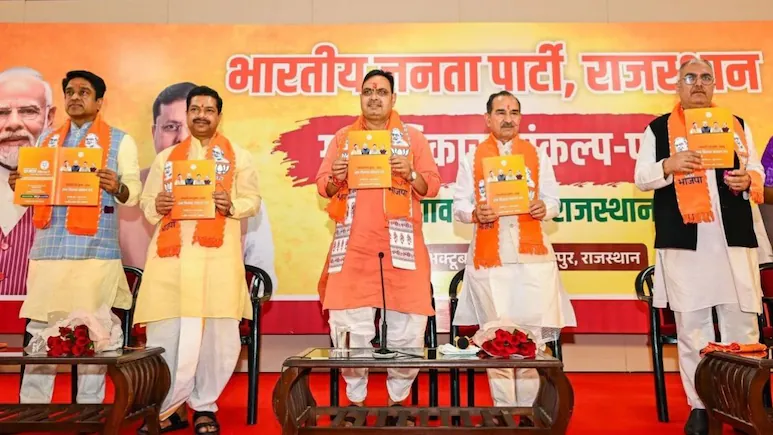
During the same visit, Nabin also advised local leaders to learn lessons from irregularities reported during the urban local body elections. Today, the Bharatiya Janata Party released a state-level manifesto for the Panchayati Raj elections for the first time, along the lines of manifestos issued for Assembly and urban local body elections. The BJP is putting the same level of effort as it does in assembly and Lok Sabha polls. From the state BJP committee and the Chief Minister to the party’s national president, the leadership is actively participating in campaigning and preparations for the Panchayati Raj elections. These vehicles are travelling across the state to spread the BJP’s message. He directed them to address issues such as cross-voting and the practice of keeping elected representatives together in resorts to prevent defections. The document has been named the Sankalp Patra. This is the first time the party has issued such a comprehensive manifesto for Panchayati Raj elections. This time, elections to all panchayats in the state are being conducted together for the first time. The elections are being organised along the lines of the ‘One State, One Election’ approach. The BJP had also adopted a centralised system for the urban local body elections. The Congress strongly criticised the Chief Minister’s participation in these local elections, but the BJP defended it as part of its electoral strategy. The BJP held consultations at several levels while preparing its manifesto. The party spoke to local leaders and people from rural backgrounds in an effort to make the document inclusive. Keeping Rajasthan’s geographical and cultural diversity in mind, the manifesto has been prepared to address the concerns and aspirations of different regions and sections of society. NDTV has attempted to explain the manifesto in simple language. The Sankalp Patra covers a range of subjects, including education, healthcare, women’s welfare, youth employment, the economy and infrastructure. Under the ‘One Block, One Blood Bank’ initiative, blood banks will be established in every panchayat samiti area. Every gram panchayat in Rajasthan will have at least one senior secondary school.
On September 25, BJP national president Nitin Nabin visited Rajasthan. During his visit, he flagged off 90 campaign vehicles to promote the party’s policies. Chief Minister Bhajanlal Sharma himself held roadshows in all 10 major cities with municipal corporations. The party subsequently formed boards in 204 urban local bodies across the state. The assistance provided under the Pradhan Mantri Matru Vandana Yojana will be increased from Rs 5,000 to Rs 8,000. Students from economically weaker families will receive annual assistance of Rs 1,200 to purchase school bags, books and uniforms.
Reacting to the manifesto, Rajasthan Congress president Govind Singh Dotasra said the government had not released funds promised under earlier announcements. He alleged that panchayat elections had not been held for two years and that not even a single rupee had been released. Atal Gyan Kendras will be developed in every gram panchayat. These centres will provide internet access, digital libraries, study material for competitive examinations and career guidance. Atal Gyan Kendras will also be developed in every gram panchayat to help young people prepare for competitive examinations and access career guidance. The BJP has set a target of providing regular Rajasthan Roadways bus services from every gram panchayat to its respective district headquarters. Mini-bus services and other rural transport facilities will also be expanded as required. Every gram panchayat will be connected to the internet. The process of granting property rights and ownership titles to eligible families under the Swamitva Scheme in rural settlement areas will be expedited. Arrangements will also be made to identify landless rural families and provide them with residential plots at reasonable prices. The manifesto also proposes providing a Grid Sub-Station (GSS) facility in every gram panchayat. Farmers across all districts will be provided electricity during the daytime for irrigation. Subsidies will be extended to two lakh farmers for irrigation pipelines. An Amrit Sarovar will be developed in every gram panchayat. The initiative will include the restoration and construction of traditional water bodies such as ponds and stepwells. An MSP-based procurement arrangement will also be made for jowar and bajra. The manifesto also proposes establishing one vermicompost unit in every gram panchayat and preparing a pasture development plan for each panchayat. Collection centres will be established in every panchayat samiti area for the collection, grading, packaging and primary processing of agricultural produce. To support animal husbandry and strengthen the rural economy, five lakh additional Pashudhan Kisan Credit Cards will be issued over the next five years. The BJP claims that its manifesto takes into account the needs of all sections of society and regions of Rajasthan. However, the Congress has dismissed it as merely an election-time promise. He also questioned why administrators had been appointed in place of elected representatives and why elections were not being allowed to take place. Amid this exchange of allegations and counter-allegations, both major political parties are preparing to enter the electoral battlefield. the BJP has drawn up an action plan that involves everyone, from the party’s top leadership to its grassroots workers While the Congress is once again looking to fight the elections primarily at the local level.
The BJP has promised to facilitate 10 lakh employment opportunities in the government and private sectors. Rajasthan has vacancies for 1.18 lakh posts, and preparations are underway to recruit candidates for 70,031 of these positions. To encourage startups in the agricultural sector, the Rajasthan Agriculture Accelerator Mission will be launched with an investment of Rs 500 crore. The monthly pension for all eligible widowed women will be increased to Rs 1,500. Under the Pradhan Mantri Matru Vandana Yojana, financial assistance for women will be increased from Rs 5,000 to Rs 8,000. Female athletes will also be provided financial assistance of up to Rs 5 lakh to encourage their participation and achievements in sports. More than 3,000 kilometres of rural roads will be constructed under the Pradhan Mantri Gram Sadak Yojana. In addition, more than Rs 9,000 crore will be spent on the construction of 19,000 kilometres of missing-link roads. Over the next five years, development works worth an average of Rs 5 crore will be undertaken in every gram panchayat across the state. Ideal markets will be developed in all revenue villages with a population of more than 5,000. Villages with a population exceeding 1,000 will have public parks, open gyms and food courts. The government aims to distribute 25 lakh Swamitva cards/property titles in the coming years. The Rs 34,102-crore Yamuna Water Project will provide water for drinking and irrigation purposes in the Shekhawati region. The annual assistance provided to farmers under the PM-Kisan Samman Nidhi will be increased to Rs 12,000. Wheat will be procured at Rs 2,700 per quintal by providing a bonus over and above the Minimum Support Price (MSP). Over the next five years, assistance will be provided for 1,000 lakh metres of field fencing. Shade nets and greenhouses will be established across an area of 25 lakh square metres. Subsidies will be provided for 50,000 agricultural machinery units. To ensure that dairy farmers receive fair prices for their milk, 20,000 dairy cooperative societies will be established. People interested in poultry farming will be eligible for loans of up to Rs 10 lakh at low interest rates. The Camel Conservation and Visa Mission will be launched with an investment of Rs 100 crore.
