
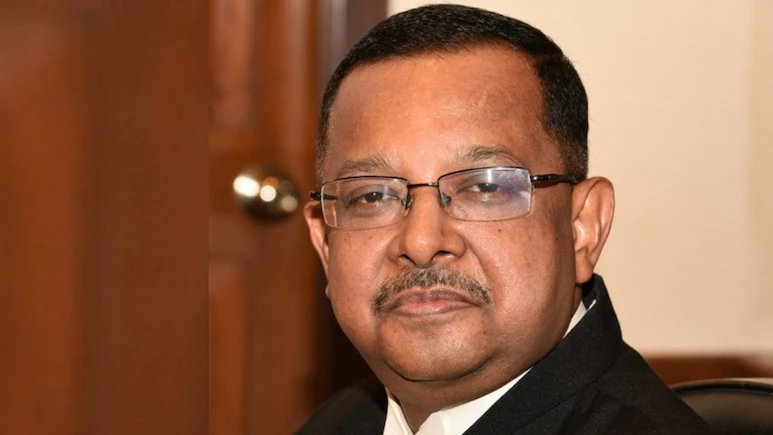
Justice Ujjal Bhuyan of the Supreme Court on Sunday called “a negation of the constitutional order” any process that takes away the voting rights of a huge number of Indian citizens. He asserted that “no authority can do it; no court can condone it”.
“If any process results in disenfranchising millions and millions of Indian citizens — making them second-class citizens in their own country in the sense of being citizens without voting rights — such a process is intrinsically arbitrary. No amount of whataboutery can justify it… He did not name any specific exercise or authority in his address. The remarks come four months after the Supreme Court unanimously upheld the Election Commission of India’s Special Intensive Revision (SIR) of electoral rolls. Recent weeks have seen fresh questions by Opposition parties over the EC’s autonomy and intention. “From the persona of an Indian citizen, the right to vote or right to be included in the voters list cannot be detached. Watch below: Video of Justice Ujjal Bhuyan’s address at NALSAR
He termed such an exercise violative of the Constitution’s Article 14, which guarantees the right to equality, and Article 326, which provides for universal adult suffrage.
“The Indian Constitution does not provide for two classes of citizens: citizens with voting rights and citizens without voting rights,” Justice Bhuyan said in a speech in Hyderabad. It strikes at the very heart of the Constitution,” he said. “I would go to the extent of saying that it is a negation of the constitutional order which we have adopted under the Constitution of India,” he added. It will be like taking out the soul from the body,” the judge said.
Justice Bhuyan was delivering the valedictory address at the 19th NALSAR-Justice BR Sawhney Memorial Moot Court Competition at NALSAR University of Law, where he earlier served as chancellor.
On the SIR, the SC ruled in May that the exercise fell within the poll body’s mandate and that the measures adopted were not excessive or disproportionate. It also held that where the commission is not satisfied a person meets the conditions for inclusion, it may refer the case to the competent authority for adjudication. “Indian citizens’ right to vote is intertwined with India’s long years of struggle against foreign rule. No authority can do it; no court can condone it. Each generation will have to defend it and fight for it. Then alone, will it survive, to be passed on to the next. Citing US Supreme Court judge Felix Frankfurter’s view that the highest office in a democracy is not that of the President but that of the citizen, Justice Bhuyan quoted him as saying: “Democracy is always a beckoning goal, not a safe harbour; for freedom is an unremitting endeavour, never a final achievement. READ | Gyanesh Kumar Has An Immunity Pin.
Appellate tribunals for some exclusion cases have been set up in West Bengal, for instance, where 93 per cent of the matters decided so far have ended with re-inclusion of the voter. READ | Form 6 For New Voters: When A Small Change Triggered A Big Row Justice Bhuyan, in his address on Sunday, spoke in a wider sense and linked the vote to India’s Independence too. “Article 326 cannot be tinkered with at all. READ | After NALSAR, Another Top Law College Opposes Invite To Chief Justice He recalled jurist Nani Palkhivala’s 1979 convocation address at the University of Madras: “Freedom cannot be inherited in the bloodstream.
Opposition parties have called the SIR a “sinister” exercise and demanded the restoration of about 13 crore names excluded from draft rolls across the three phases so far, particularly after recent resorts of dissent within the poll body. It is a manifestation of our freedom achieved after so much of struggle and sacrifice,” he said. No one is above the Constitution,” he said. He said that, except in the case of a dead voter, “the name of a voter once enlisted in the electoral roll cannot be deleted without notice and hearing”. “And what is the worth of a citizen without her voting right,” he asked. Why A Petition Says He Can’t Use It He said that while the Indian Supreme Court has held that voting is not a fundamental right, it has recognised it as a constitutional right. “Therefore, in my view, the right of an Indian citizen to cast his vote is central to the Basic Structure doctrine itself,” he said. Describing universal adult franchise as the Constitution-framers’ “act of faith” in the common man, he said, “One may be a billionaire, and one may be a rickshaw puller; yet both will have their votes, and the value of their votes would be equal.”
