
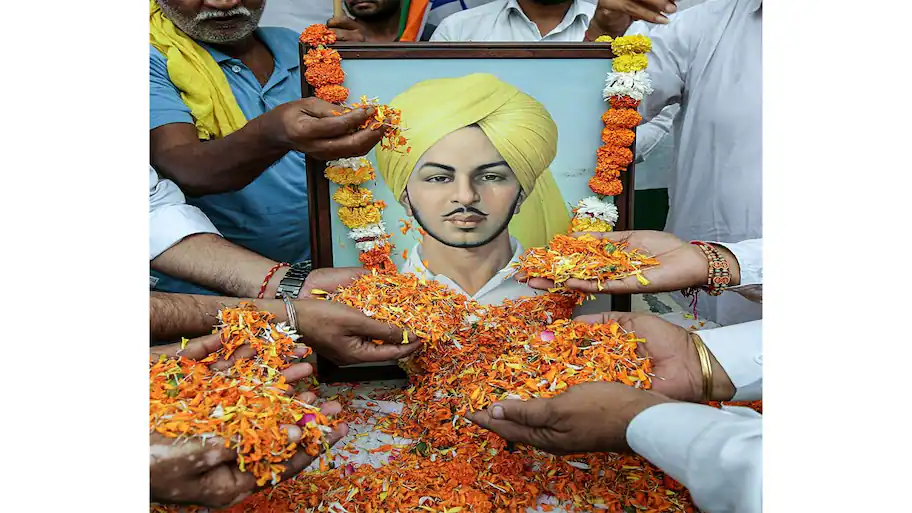
New Delhi: Forget the guns, the bombs and the courtroom defiance. On Bhagat Singh’s birth anniversary, one of his most revealing stories comes from a bitter fallout with his closest friend, Sukhdev, and the fiercely honest letter that followed.
He was arrested days after the bombing during raids against HSRA members.
Sukhdev was known for his strict manner and his commitment to the revolutionary organisation. Historian Shiv Verma described him as a person who had great affection for his comrades. His relationship with Bhagat Singh was especially close. During the argument, he accused Singh of becoming afraid of death and of believing that he was indispensable to the organisation. One version records him telling Singh, “You have become arrogant. You think you are indispensable for the party. You have started fearing death and have become a coward. Another version of the story connects the argument to Singh’s views on love. The identity of the woman has been disputed by historians. Kuldip Nayar identified her as Durgawati Devi, who was known as Durga Bhabhi, the wife of revolutionary Bhagwati Charan Vohra. There is no first-hand record establishing that identification, so the claim needs to be treated as a historical claim rather than settled fact. He used Giuseppe Mazzini as an example and wrote about how a letter from a woman Mazzini loved helped him recover from despair after the failure of an uprising and the deaths of his comrades. His larger point was about sacrifice. Singh wrote that a person who has ambition, hope and attachment to life can still give all of it up when duty demands it. The letter also asked Sukhdev to reconsider the strict moral standards that had influenced their thinking. He asked his friend not to judge people harshly for ordinary human emotions and urged him to show sympathy to those struggling with them. The two friends had discussed Victor Hugo’s novel ‘Ninety-Three’, which is set during the French Revolution. One of its central characters, Cimourdain, is forced to confront his affection for Gauvain, a young revolutionary he regards almost like a son. Sukhdev saw Cimourdain’s final act as a warning. Bhagat Singh had sympathy for the character and his emotional struggle. Singh believed revolutionary commitment did not erase human bonds. He saw affection as part of human life and believed it could coexist with the willingness to sacrifice. His argument was not that love should come before revolutionary duty. He wrote that a revolutionary could experience love and still surrender everything he valued when duty demanded it. His later writings offer another side of his relationship with Singh. He wrote about the pain of separation from his closest friend and described the effect Singh’s absence had on his life. The letter was highly personal. Sukhdev described continuing his work after Singh’s departure and struggling with the loss of the companionship that had become such an important part of his life. The two men also continued to exchange ideas after their arrests. Their views on love and suffering developed further during imprisonment. He argued that ending one’s life to escape suffering was not compatible with the principles they had once defended. By then, the two men were facing the possibility of execution.
Because of his fascination with a woman, sukhdev was said to have accused him of avoiding his revolutionary duty. Because there is something valuable to give up, the sacrifice becomes meaningful precisely. Bhagat Singh’s April 5 letter makes his views clear. That idea also appeared in his April 5 letter. A letter Bhagat Singh wrote to Sukhdev in 1930 shows that both men had changed in some ways.
He told Sukhdev that love did not make a revolutionary weak. “Love always elevates the character of man,” he wrote, describing true love as a deeply human feeling and arguing that affection could strengthen a person’s character. Singh referred to “over-idealistic Arya Samajist conception of morality”.
Their disagreement about love had existed before the assembly plan. He referred to Sukhdev’s changing views on love and reminded him of their earlier argument over suicide.
The letter was later recovered from Sukhdev after his arrest and became part of the evidence in the Lahore Conspiracy Case. The argument started over a simple issue. Singh wanted to hurl the bombs and give court arrest. The plan had been accepted by the Hindustan Socialist Republican Association (HSRA) as a way to protest the Public Safety Bill and Trade Disputes Bill. The group also wanted to use the trial to explain its political ideas to a larger audience. The central committee initially refused to send him. Chandrashekhar Azad was among those who opposed the idea. Singh was seen as too important to lose. Sukhdev was away from the meeting when the decision was made. When he returned to Agra and heard about it, he gor upset and angrily reacted to the decision. He knew that the mission could lead to death. He also believed Singh was the person best placed to explain the HSRA’s politics during the trial. The plan had been carefully worked out. Singh and Dutt were expected to throw low-intensity bombs and surrender. The intention was to make a political statement and attract public attention to the organisation’s ideas. The pamphlet thrown in the central hall featured the famous line, “It takes a loud voice to make the deaf hear. Historical records also confirm that the bombs were not intended to cause deaths and that the two revolutionaries made no attempt to escape after the explosions. The decision to send Singh was eventually changed after his insistence. Sukhdev sat through the subsequent meeting without saying anything. Singh was allowed to take part in the action. The exchange between the two friends had left a deep mark on both men. Singh and Dutt tossed two bombs in the Central Legislative Assembly, threw pamphlets and surrendered. Singh also fired two shots into the air. He was later implicated in the Saunders murder case through ballistic evidence. The Lahore Conspiracy Case eventually ended with Singh, Sukhdev and Rajguru being sentenced to death. It records a disagreement between two young men who were prepared to give their lives for their cause. It also shows Bhagat Singh trying to explain why human emotion, in his view, had a place in the life of someone committed to revolution.
The letter was written on April 5, 1929, three days before he along with Batukeshwar Dutt threw bombs in the Central Legislative Assembly in Delhi. The bombing took place on April 8, 1929. They were executed on March 23, 1931. The April 5 letter offers a rare glimpse into the personal world behind the revolutionary image.
He addressed Sukhdev as “dear brother” and wrote about love, human emotions, sacrifice and what it meant to live as a revolutionary.
