
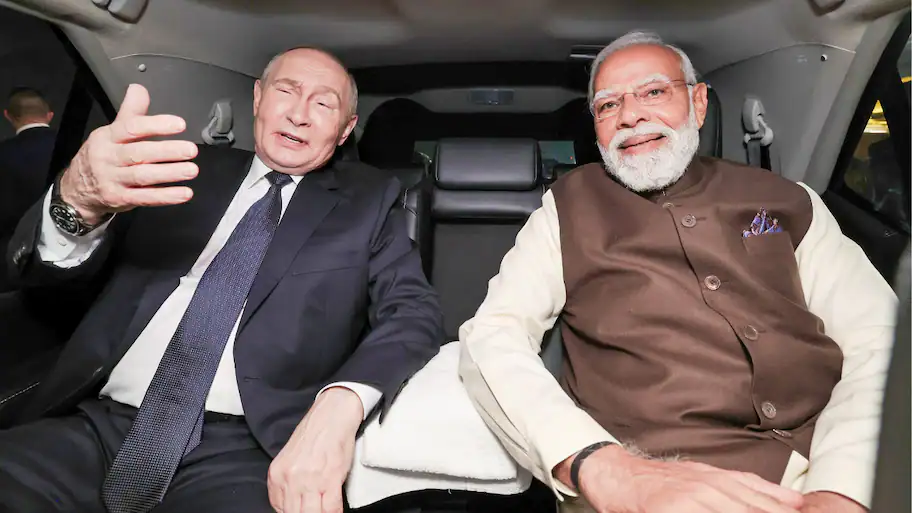
Russian President Vladimir Putin is set to visit India for the 18th BRICS Summit in New Delhi, a trip that carries strategic significance far beyond routine bilateral engagements.
As fresh diplomatic initiatives gather momentum to end the Russia–Ukraine war, Putin’s bilateral meeting with Prime Minister Narendra Modi arrives at a critical juncture. “In a couple of days, President Putin will begin his visit to India. The timing is important. Just days before Putin’s India visit, US President Donald Trump’s envoys Steve Witkoff and Jared Kushner met Putin in Moscow for more than three hours. They then travelled to Kyiv and held talks with Ukrainian President Volodymyr Zelensky. it has given diplomacy around the war a fresh push While the Moscow meeting did not immediately produce a major breakthrough. India has consistently maintained that the Russia-Ukraine war must ultimately end through dialogue and diplomacy. Prime Minister Modi has stayed in touch with both sides during the conflict and has repeatedly stressed the importance of peace. New Delhi has also avoided becoming part of the Western pressure campaign against Moscow, while making it clear that war is not a solution. That position was reinforced recently by External Affairs Minister S Jaishankar. It will end when there is diplomacy, dialogue and negotiation. That makes the upcoming Modi-Putin conversation particularly relevant, especially after the recently concluded SCO (Shanghai Cooperation Organisation) summit in Bishkek, Kyrgyzstan. There is another reason the visit matters for New Delhi. India has strong strategic ties with Russia, particularly in defence and energy. At the same time, it has maintained relations with Ukraine and dialogue with the United States and European countries. This gives India a unique position. New Delhi can speak to Moscow without cutting ties with the West, while also keeping communication channels open with Kyiv. Jaishankar’s recent comments reflected this approach. But at the same time, New Delhi has made it clear that economic pressure alone cannot bring an end to the war. Beyond the BRICS summit and bilateral relations, the meeting between the two leaders comes when the US is making another attempt to push Russia and Ukraine towards negotiations, Moscow is signalling that it remains open to a trilateral format, and India is once again emphasising the need for dialogue. Whether that translates into any concrete movement on the Ukraine war remains uncertain, but when Putin sits down with Modi in New Delhi, the Russia-Ukraine war is likely to be an important part of the conversation and the timing could make that conversation more significant than usual.
Because countries decide whether or not to buy Russian oil, minerals or other commodities, his message was straightforward on India’s Russian oil import: the war will not end. India has defended its continued purchase of Russian energy by pointing to the energy security needs of its 1.4 billion people.
Kremlin spokesperson Dmitry Peskov said Putin’s India visit would be a significant occasion for contact with Prime Minister Modi. He will take part in the BRICS summit, and it will also be a significant time for contact with PM Modi,” Peskov said. “It will also be an opportunity for President Putin to inform his Indian friend about the situation on the war with Ukraine,” added Peskov. The Kremlin has also now said that Russia does not rule out restarting trilateral talks involving Russia, Ukraine and the United States. During his visit to Poland, Jaishankar said India has been in continuous contact with both Russia and Ukraine and is looking at ideas that could help reduce tensions and eventually end the conflict.
The discussions are expected to center on strengthening bilateral ties between Moscow and New Delhi, as well as recent US-led diplomatic efforts aimed at bringing Russia and Ukraine back to meaningful peace negotiations. Putin is likely to have his own assessment of the discussions with Trump’s envoys. Modi could use the opportunity to understand Russia’s position on any possible ceasefire, negotiations and the conditions Moscow would seek for a settlement. India may also reiterate its long-standing position that there is no military solution to the conflict. This does not necessarily mean India will act as a formal mediator. Instead, its strength lies in being able to maintain communication with countries that are increasingly divided over the war. The latest developments suggest that diplomacy has not completely run out of steam. Russia and Ukraine remain far apart on some of the biggest issues, particularly territory and security guarantees. Kyiv has rejected any settlement imposed without its consent, while Moscow continues to demand concessions from Ukraine. But the recent meetings involving Putin, Trump’s envoys and Zelensky suggest that Washington is once again trying to find a way forward. And Putin’s India visit comes right in the middle of this renewed diplomatic activity.
The Kremlin’s willingness to consider renewed trilateral talks could therefore be an important development.
Earlier rounds of Russia-Ukraine-US talks in Abu Dhabi and Geneva eventually stalled.
