
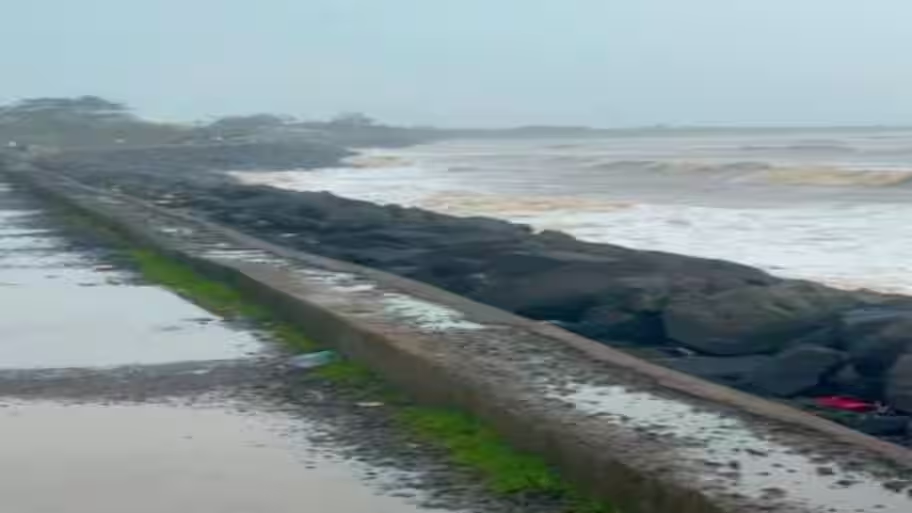
Ahmedabad: There was a time when the Arabian Sea was more than two kilometres away from Bhagal village in Gujarat’s Valsad district. Coconut groves stood along the coast, farmers got fresh water from wells and fishermen used the shoreline to keep their boats and equipment.
Tandel says the wells and coastal areas once used by fishermen have been lost to the sea. The problem has spread beyond lost land in Bhagal. Erosion has also been reported in Bhavnagar, Amreli, Junagadh, Porbandar, Gir Somnath and Devbhoomi Dwarka.
Today, much of that land has disappeared into the sea. In some places, only a narrow strip of land separates the sea from homes and farms. Bhagal is among nearly a dozen villages in the area facing the effects of rapid coastal erosion. Residents fear that heavy rain or high waves could wash away the remaining strip of land and leave the village exposed. He has also compared the possible impact of extreme water flow to the flooding recently seen in Nepal. The villages of Danti, Kakvadi, Dandi and Bhagal lie close to one another along the Valsad coast and are all dealing with the advancing shoreline. The Gujarat government has started work on protection walls, and one has been built near Danti. Residents of other villages are asking for similar structures along their stretches of coast. Saltwater has begun affecting the soil, making it difficult to grow crops that once did well in the area. Some farmers have planted paddy this year. However, lack of rain for the past two weeks has allowed salinity to affect the roots, turning the plants white. Farmers fear the crop could fail if there are no showers soon. Heavy rain brings another problem. Residents see a protection wall as the best way to stop the sea from eating into their land and prevent saltwater from reaching their fields. However, experts say only a wall may not deal with the causes of erosion. He argues that efforts to control coastal erosion must first address human activity affecting natural coastal processes. He cites illegal sand mining as one factor that can speed up erosion. Removing large amounts of sand creates gaps in the seabed, and natural movement of soil and sediment then works to fill those spaces. Material can be pulled away from nearby areas in the process, increasing erosion along the coast. The worst-affected districts include Valsad, Navsari, Surat, Bharuch and Jamnagar. The Bhagal belt was placed in the moderate-erosion category. Bhagal residents are demanding a protection wall near the village.
Because the village lies below sea level, the situation is worrying here. Because they cannot tolerate high levels of salt, rising salinity has damaged the boda trees, while coconut trees have also disappeared. Because it is located below sea level, he says the village needs special attention.
Sumanbhai Tandel, a resident, says the shoreline has moved closer and closer to the village over the past 15 to 20 years. He believes 12 to 15 villages could eventually disappear if erosion is not checked soon. Bhagal has a population of around 3,000, with most families depending on farming and fishing. The village has a school up to grade 7, while students seeking further education have to travel 10 to 12 kilometres. The government told Parliament in 2026 that around 58% of Valsad’s coastline had been affected by erosion, while some degree of erosion had been recorded along 60% of the coastline in Navsari. A study by the National Centre for Coastal Research covering data between 1990 and 2022 classified the area above Udvada in south Gujarat as a high-erosion zone. The study examined 32 years of coastal erosion data but did not make recommendations on coastal protection measures. Valsad MLA Bharat Patel said the taluka has around 16 kilometres of coastline covering villages including Dandi, Bhagal, Kakvadi, Kosamba and Danti. He said the government has so far approved around Rs 200 crore for protection walls along the coast. Another Rs 200 crore to Rs 250 crore could be needed to build a wall along the full stretch, according to him. He said Danti and Kakvadi have the greatest need for protection and that the central government provides 90% of the funding for such coastal protection projects.
Anand Patel, the village sarpanch, says Bhagal was once known for its boda (a local crop) fields, along with good production of guar (cluster beans) and coconuts. Patel says the road connecting the village can be covered with water up to chest level every year during periods of intense rainfall. M S H Sheikh, chairman of the Brackish Water Research Centre in Surat, says even the protection wall could be damaged by strong waves within a few years. Patel says they have raised the issue repeatedly with local leaders and cites the wall built near Danti as an example. Patel said he has also spoken to the Gujarat chief minister and state finance minister about extending protection work to Bhagal and other villages along the coast.
For that reason, he believes simply building walls along the shoreline will not provide a lasting solution. His other suggestion is relocating communities that face the greatest risk. Coastal erosion has affected large parts of Gujarat. Climate change and human activity are among the factors behind the problem, and several districts have recorded substantial changes along their shorelines.
The state lost more than 537 kilometres of coastline to erosion over the previous 28 years, according to the 2024 Environmental Statistics. The state government told the 16th Finance Commission that 449 villages in Gujarat had been affected by coastal erosion.
He says changes to rivers and large-scale removal of sand can disturb the natural movement of sediment.
