
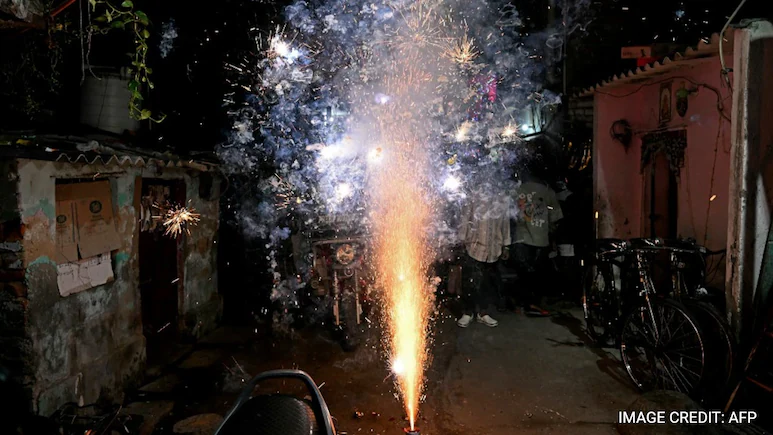
Every winter, a familiar trope, a suffocating routine, awaits Delhi. Temperatures drop, winds calm down, and the skies turn a gloomy grey. As the season changes, the pollution becomes worse – thanks to festive emissions, vehicular pollution, construction dust, stubble-burning residue, and more.
Bhalla explains, “Green crackers are nothing more than greenwashing. Documented evidence shows that so-called ‘green crackers’ rarely meet the prescribed emission thresholds. If a bureaucrat like Tukaram Mundhe were overseeing manufacturing and supervision with strict, uncompromised enforcement, maybe we could talk, but right now? It’s just another term invented to throw dust in our eyes – literally. Offering a technical look at the framework, environmentalist Siddhant Sarang notes that while green crackers are a step towards reducing the environmental impact of firecrackers, they should not be mistaken for pollution-free crackers. Echoing this, Bhalla adds: “We need to stop treating firecrackers as the sole alpha and omega of our air pollution crisis, but we also shouldn’t downplay their immediate devastation. However, science and data tell us that Delhi’s crisis is a year-round, regional fossil-fuel and governance problem. Stubble burning accounts for only a minor slice of the annual pie, and crackers are a severe seasonal shock. But the baseline poison comes from our vehicles, industrial clusters in the airshed, secondary particles, and year-round dust. Further, CREA’s findings reveal alarming data gaps during the peak of the pollution event.
Research conducted by Dr Manoj Kumar of the Centre for Research on Energy and Clean Air (CREA) revealed that Diwali 2026 was the fourth most polluted day of the year, registering a staggering daily average PM2.5 concentration of 257. The preceding days – November 5, 6, and 7 – also ranked among the worst air quality days of 2026, securing the sixth, seventh, and eighth spots, respectively. Diwali 2026 also marked the fourth most polluted Diwali since 2016. An IIT-Delhi study published in 2022 found that fireworks account for roughly 95 per cent of elemental PM2.5 during peak celebrations. Firecrackers cause massive, concentrated toxic spikes right after festivals like Diwali, shooting PM2.5 levels off the charts overnight. Missing Data: 36 monitoring stations lacked hourly PM2.5 data at 1 am on November 9, right when pollution levels peaked amid stagnant atmospheric conditions.
