
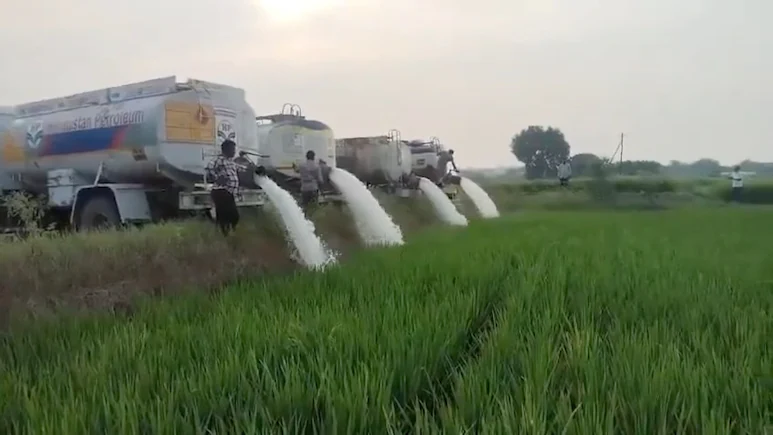
Farmers across Telangana are struggling to protect standing crops amid a prolonged dry spell, declining reservoir storage, and concerns over irrigation water and electricity availability.


So we brought a tanker and connected the water pipes.”
Explaining why he turned to a tanker despite uncertain returns, Narsaiah said, “Whether we get profit or not, how can we lose the crop that has come to this stage?
He also appealed for greater government attention to farmers’ needs, arguing that reliable electricity and adequate water storage are essential for sustaining agriculture. He highlighted the wider dependence of rural Telangana’s livelihoods and ecosystems on agriculture. Twelve districts received no rainfall during the period. Water availability has also deteriorated. The crisis has also triggered a political row. BRS working president KT Rama Rao (KTR) accused the Congress government of failing to utilise available river water and operate key lift-irrigation projects despite warnings about El Nino.
Responding to the Revanth Reddy government’s appeal for a farm holiday, he said, “Only if a farmer does agriculture do they survive; if the farmer takes a holiday, these 99 living beings will be in chaos. Telangana recorded just 3.5 mm of rainfall against the normal 75.6 mm between October 1 and 21, marking a 95% deficit, according to India Meteorological Department data. The southwest monsoon had already ended with a 17% seasonal deficit, with the state receiving 615.5 mm of rainfall against the normal 740.6 mm. The combined storage in major and medium reservoirs across the Krishna and Godavari basins stood at 503.43 TMC on September 30, compared with 834.92 TMC on the corresponding date last year, a decline of nearly 40%, according to irrigation department data.
“This is not a drought brought by fate, but one created by Congress,” KTR said, alleging that more than 750 TMC of Godavari water and 250 TMC of Krishna water had flowed downstream since June 1.
