
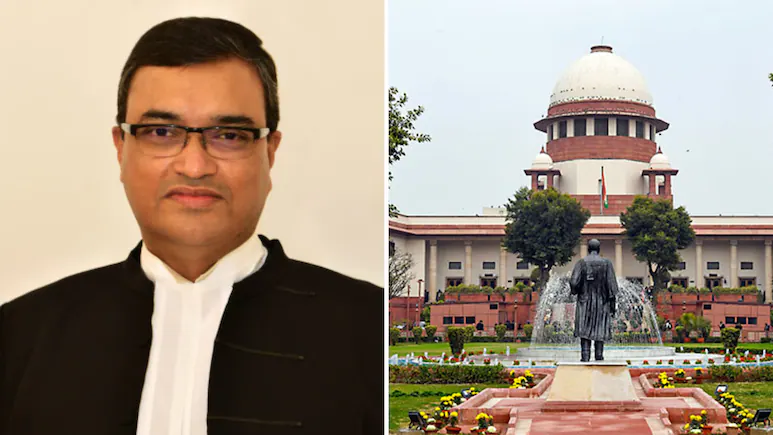
When Justice Dipankar Datta of the Supreme Court on Wednesday raised questions about the method of appointing Election Commissioners, the government lawyer mentioned how judges are appointed. It drew a sharp reaction from the bench.
Justice Datta said, “The oft-repeated phrase that ‘judges appoint judges’ is a myth,” and noted that the government is selective in clearing the Collegium proposals on appointments.
Instead, a Union Cabinet Minister was made part of the panel, with the remaining two members being the Prime Minister and the Leader of the Opposition. Justice Datta made the remarks while addressing the submission by Solicitor General Tushar Mehta during the hearing of petitions challenging the 2023 law that gives more say to the government in appointments to the Election Commission of India (ECI). Petitions against the law raised concerns about the PM and a minister nominated by the PM effectively getting a 2:1 majority against the Leader of Opposition, who is the third member of the selection panel. He rejected the central government’s argument about the Collegium as a possible way to justify the selection panel proposed under the 2023 law for election commissioners’ appointment. The observations were part of Justice Datta’s ruling on the question of whether petitions challenging the Chief Election Commissioner and Other Election Commissioners (Appointment, Conditions of Service and Term of Office) Act, 2023, need to be referred to a larger Bench. The 2023 law created a three-member Selection Committee for appointing the Chief Election Commissioner (CEC) and other Election Commissioners. Notably, while the earlier selection mechanism required consultation with the Chief Justice of India (CJI), the selection panel laid down under the 2023 law did not include the CJI.
“The oft-repeated phrase that ‘judges appoint judges’ is a myth, which people have been fed by vested interests through motivated narratives, often drawing sustenance from certain controversial decisions taken in this century in relation to the appointment of judges,” he said. “A sweeping generalisation that the Collegium acts as a law unto itself overlooks the detailed consultative process envisaged under the Constitution and the intrinsic role of the executive, both at the Centre and in the States, as well as intelligence and other agencies in the appointment process, including vetting of credentials, and the fact that every appointment bears the imprimatur of the President,” he added. “This court is left to wonder why, even after the judiciary has been relegated to playing second fiddle to the executive in the matter of appointment of judges, is there still a clamour to induct an outsider at the stage of selection (of election commissioners)?” he said.
