
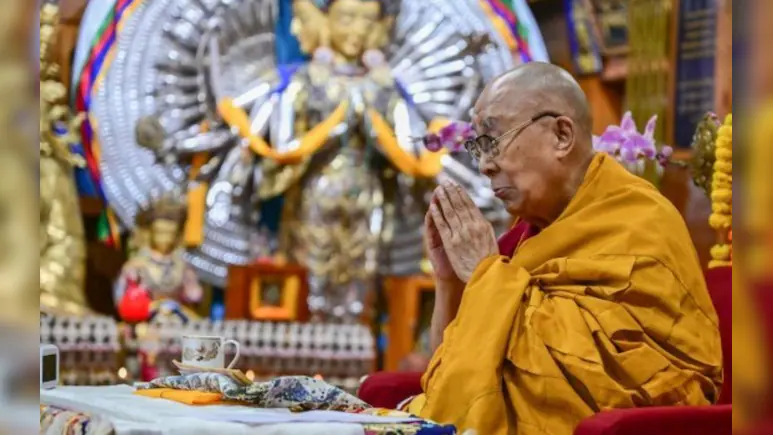
Tibet’s government-in-exile wants Tibetans and Buddhists everywhere to start getting ready for the Dalai Lama’s succession. It also wants foreign governments to refuse any reincarnation process run by Beijing.
And even as it makes that demand, the administration says it’s sticking with the Middle Way Policy, though it admits China’s stance shows “no indication of an opening” for talks.
The cabinet members of the Central Tibetan Administration speaking to NDTV in Dharamshala laid out the cabinet’s priorities. Who gets to recognise his successor is now a sensitive issue between the exiles and Beijing. The cabinet members call Gyaltsen Norbu, the Panchen Lama recognised by China, a state-backed proxy. It once again demands the release of Gedhun Choekyi Nyima, whom the Dalai Lama recognised as the 11th Panchen Lama. The CTA wants other Tibetan political prisoners freed too. Why the Middle Way stays
The succession fight The Dalai Lama turned 91 in 2026. Against that, it cites around 150 resolutions and statements from governments and Tibetan Buddhist organisations that oppose Chinese interference. More than 38 countries, it says, back its position. He was taken into Chinese custody in 1995.
The CTA says China has repeatedly spelt out “three conditions” for his reincarnation.
Tibetan Government-in-Exile Tells World: Prepare Now for Dalai Lama’s Succession
The policy seeks genuine autonomy for Tibet within China, not independence. “Talks did happen. Now the CTA is seeking “fresh momentum. It’s asking foreign governments to push Beijing back to the table, without preconditions. In the CTA’s view, the law treats the dispute as unresolved, and it hopes other democracies will see it that way too. The CTA calls it one of the most serious threats to Tibetan identity it has ever faced, a “legally masked strategy to erase Tibetan identity. One provision reaches beyond China’s borders. It sees that as a potential threat to anyone overseas who backs Tibetans or criticises Beijing. The paper repeats the CTA’s claim that about one million Tibetan children are in state-run boarding schools. Beijing rejects the charge that its policies aim to erase Tibetan identity. The figures and allegations here are the CTA’s own, and the document doesn’t back them with independent evidence. Life in exile The CTA members also talk in detail about the Tibetans living mostly in India, Nepal and Bhutan, where the CTA runs welfare and community services. The Kashag promises regular financial reporting, a review of its list of people living in destitution, and more housing for elderly Tibetans and people with special needs. Youth support schemes, community revolving funds and tourism are meant to help settlements pay their own way. On education, the administration plans to consolidate schools in India in phases, using birth and enrolment figures to guide the decisions and avoid duplicating resources. It wants to expand Tibetan-language teaching and support Tibetan-language software and artificial intelligence tools. A central data management system, AI-assisted databases and a formal IT policy are also planned, and civil servants will get AI training. It alleges Beijing is manipulating some followers of Dolgyal, also known as Shugden. The Dalai Lama has discouraged the practice. But the allegations against its followers are contested and haven’t been independently established. The Tibetan government-in-exile wants sovereign governments, parliaments, think tanks and the media to treat the Tibet-China dispute as an international issue, not China’s internal affair. It also asks foreign governments and donors to keep supporting Tibetans, arguing they should be considered partners in bringing change to China, not merely as victims of its policies. How far any of this gets will depend largely on whether foreign governments are willing to raise the issue with Beijing. The CTA itself admits the chances of restarting formal dialogue remain uncertain.
It goes back to 1973, when the Dalai Lama decided that protecting Tibetan identity and winning meaningful autonomy mattered more than independence. CTA representatives and the Chinese government met for nine rounds between 2002 and 2010. Then the process stalled after the 2008 Beijing Olympics,” Tsegyal Chukya Dranyi, CTA’s minister for the Department of Religion and Culture, told NDTV. It also points to a 2024 US law, the Promoting a Resolution to the Tibet-China Dispute Act, as a sign of international support. A new law in Beijing The conversations with CTA ministers revolved mainly around China’s Law on Promoting Ethnic Unity and Progress, which was introduced in March and has been in force since July 1. Work has begun, the CTA says, to relocate 1,855 registered households with no home or land.
Beijing, it says, is using the courts and statutes to accelerate assimilation, monitor Tibetans more closely, and strengthen its control over religious institutions. The law would: • Make Mandarin the compulsory language of instruction preschool onwards • Put traditional weddings and funerals through the “reform of customs and practices” • Push monasteries to follow the “orientation of Sinicising religion” The CTA is also uneasy about the rules on housing, migration and inter-ethnic marriage, which it says could erode Tibetans’ standing in their own homeland, according to the CTA. It lists facial recognition, GPS tracking, DNA profiling and iris scans as surveillance tools, and says officials who don’t enforce the law strictly could be prosecuted. Organisations and individuals abroad who undermine the law could be held legally accountable, the CTA says. It says they bring development, ethnic unity and stability to Tibetan areas, which it regards as an inseparable part of China. “We pledge “zero tolerance” for sexual harassment and abuse involving women and children and will review the internal complaints committees in settlements, schools and workplaces,” says Dranyi. Fears of a split The CTA feels China could exploit regional, sectarian and political differences within the exile community, which it calls a “primary target” for attempts to sow division.
